Zygomatic Implants in Turkey: Fixed Upper Teeth When the Jawbone Is Too Thin
Zygomatic implants in Turkey give patients with severe upper jawbone loss a way to get fixed teeth without months of bone grafting. Instead of relying on the thin upper jaw, these extra-long implants anchor in the dense bone of the cheekbone (the zygoma).
This guide from the Dr. Abdurrahman Ozturk Dental Clinic in Taksim (Beyoğlu, Istanbul) explains how they work, who they suit, what the research says, and what treatment and recovery look like step by step.
Last updated: 24 November 2026
Quick answer: what are zygomatic implants in Turkey?
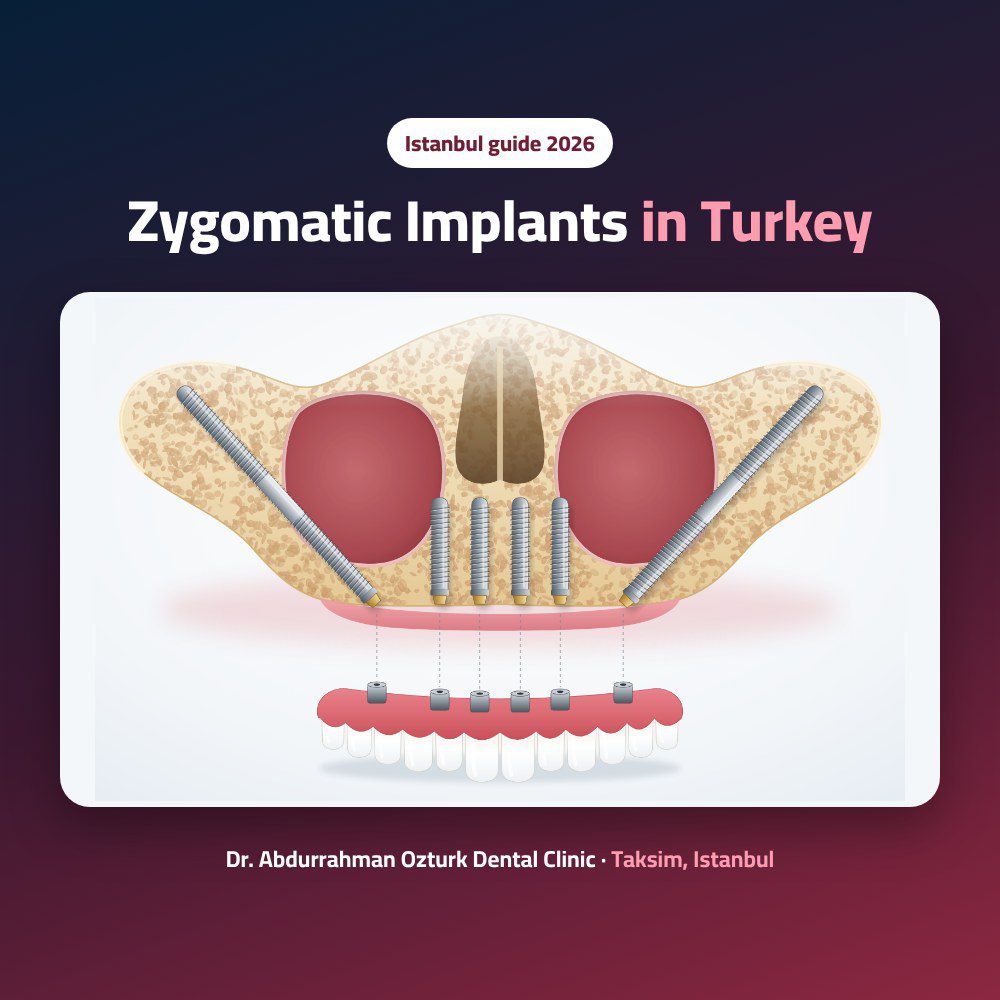
Zygomatic implants in Turkey are extra-long titanium implants, usually about 30 to 60 mm depending on the system, anchored in the cheekbone instead of the upper jaw. They support a fixed full-arch bridge for people with severe upper jawbone loss. Often a temporary fixed bridge can be fitted within days, without bone grafting or a sinus lift.
A long-term meta-analysis of 1,349 zygomatic implants reported a mean survival of 96.2% at about 6 years. Suitability is decided only after a 3D CBCT scan and a surgical examination.
Important medical note
This article is general information based on the published sources listed below and does not replace a clinical examination. Timelines, numbers of visits and treatment options are indicative and are confirmed only after your CBCT scan and consultation.
Told you do not have enough bone for implants?
Send us your CBCT scan or panoramic X-ray on WhatsApp. Our team will tell you whether zygomatic implants, All-on-4 or another option fits your case.
Send my X-ray on WhatsApp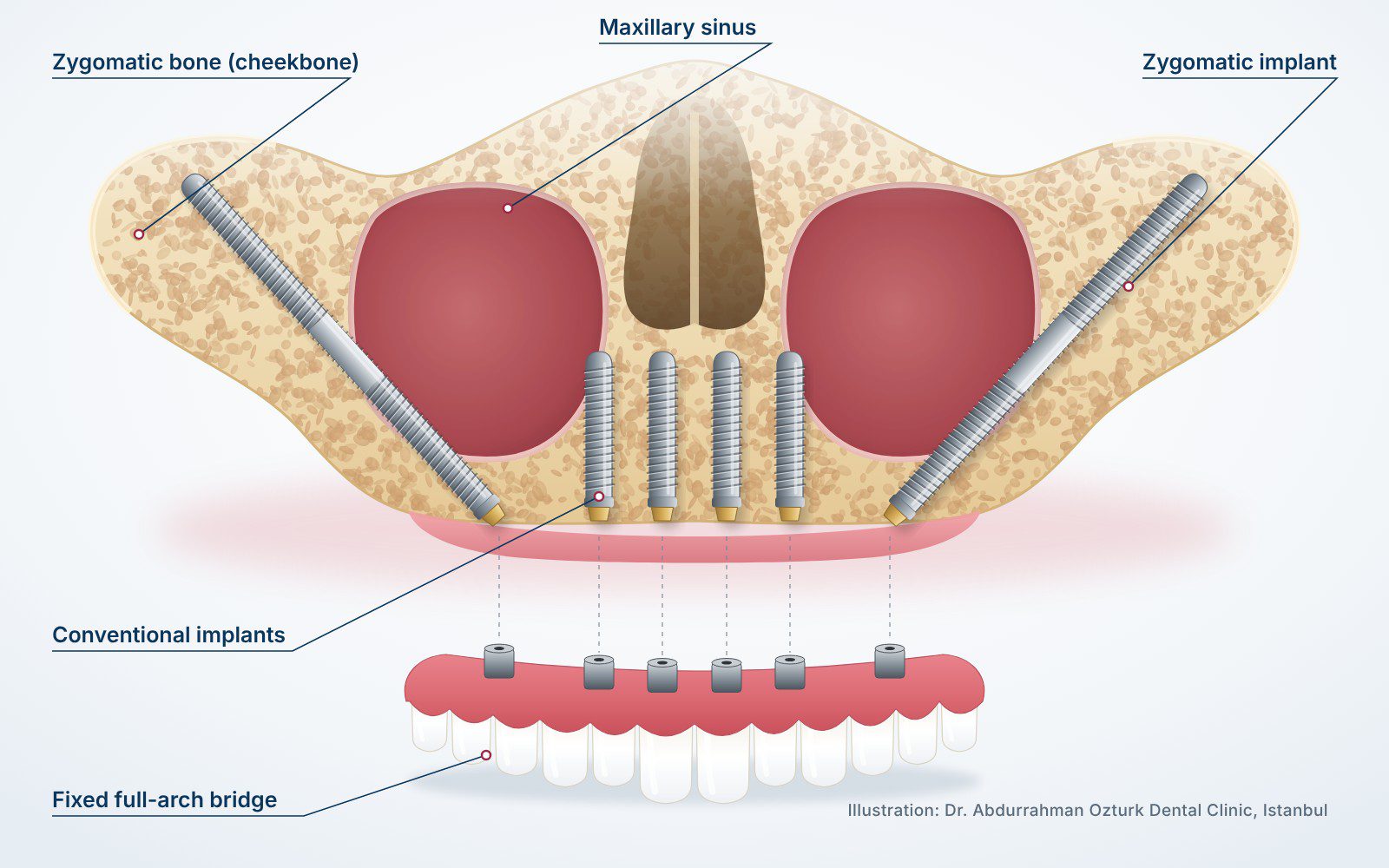
What are zygomatic implants and how do they work?
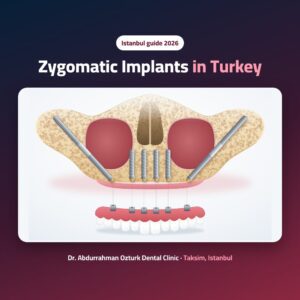
A zygomatic implant is a dental implant long enough to reach from the gum line at the back of the upper jaw up into the zygomatic bone (cheekbone). It is the same basic idea as a regular titanium implant, but much longer: available systems range from about 30 mm to 60 mm, while a standard implant is usually 8 to 13 mm long.
The concept was developed by the team of Professor Per-Ingvar Brånemark, the Swedish pioneer of osseointegration. It was first used for patients who had lost part of the upper jaw after tumour surgery. Today it is an accepted treatment for the severely resorbed upper jaw.
The key is where the implant is anchored. The upper jaw (maxilla) is mostly soft, spongy bone, and after tooth loss it can shrink to a few millimetres. The cheekbone keeps dense cortical bone throughout life. An implant anchored there can achieve strong primary stability even when the jaw below is almost gone.
Length
About 30 to 60 mm depending on the system, around three to five times longer than a conventional implant.
Anchorage
The tip is fixed in the dense cortical bone of the zygoma. The neck emerges at the gum near the premolar or first molar area.
Load
Zygomatic implants are always splinted together with other implants by a rigid full-arch bridge, so chewing forces are shared across the arch.
Our earlier introduction, What are zygomatic implants?, covers the basics. This guide goes deeper into candidacy, evidence and treatment in Istanbul.
Why does the upper jawbone shrink so much?
Bone in the jaw stays healthy because tooth roots stimulate it every time you chew. When teeth are lost, that stimulus disappears and the bone slowly resorbs. In the upper back jaw, a second process makes things worse: the maxillary sinus expands downward into the space where the roots used to be, a process called pneumatisation.
The common causes of severe upper jawbone loss are:
- Long-term tooth loss: years without teeth, especially with a removable denture pressing on the ridge.
- Advanced gum disease (periodontitis): it destroys the bone around teeth before they are lost.
- Failed implants or failed bone grafts: they can leave larger bone defects behind.
- Trauma or tumour surgery: part of the maxilla may be missing.
- Congenital conditions: some people are born with an underdeveloped upper jaw.
To learn how to slow this process early, read our guide on jawbone loss prevention.
Who is a good candidate for zygomatic implants?
Zygomatic implants are not a first choice for everyone. They are designed for patients in whom conventional implants cannot be placed in the back of the upper jaw without major grafting. Typical candidates are:
- Adults with severe atrophy of the upper jaw, where the bone height under the sinus is too low for standard implants.
- People who have been told they need large bone grafts or a sinus lift and want to avoid the extra surgeries and long waiting time.
- Patients whose previous grafts or implants failed.
- Long-term denture wearers who want fixed teeth instead of a removable plate.
- Patients with partial loss of the maxilla after trauma or tumour surgery, as part of a specialist reconstruction plan.
When zygomatic implants may not be suitable
The decision depends on your general health as much as on your bone. Extra caution, or a different plan, is needed with active or chronic sinus disease that has not been treated, uncontrolled diabetes, heavy smoking, past radiotherapy to the head and neck, and certain bone medications such as intravenous bisphosphonates. If the lower jaw or only a few teeth are involved, simpler options are usually better. If you smoke, read how smoking affects dental implants before your consultation.
Which zygomatic implant configurations are used?
The number of zygomatic implants depends on how much bone remains in the front of the upper jaw. In every configuration, the implants are joined by one fixed bridge.
| Configuration | Implants used | Typical situation |
|---|---|---|
| Zygoma + anterior implants | 1 zygomatic implant on each side + 2 to 4 conventional implants in the front | Back of the upper jaw is severely resorbed, front bone is still adequate |
| Quad zygoma | 2 zygomatic implants on each side (4 in total) | Both the back and the front of the upper jaw are severely resorbed |
| Unilateral zygoma | Zygomatic implant on one side only, with conventional implants elsewhere | Bone loss mainly on one side, or after partial resection |
| Rescue after failed treatment | Zygomatic implants added to replace failed implants or grafts | Previous full-arch treatment lost its back implants |
Surgeons also classify the anatomy using the ZAGA system (Zygoma Anatomy-Guided Approach), proposed by Carlos Aparicio. In his survey of 100 patients, the shape of the cheekbone and jaw fell into five types, ZAGA 0 to 4. The most common type, ZAGA 1, accounted for 49% of sites. Different anatomy also existed between the right and left sides in 58% of patients. This is why the implant path is planned individually for each side on the 3D scan.
For a full-arch plan using only conventional implants, compare our guides to All-on-4 dental implants in Istanbul and All-on-X dental implants.
Zygomatic implants vs bone grafting, sinus lift and All-on-4: which is right?
All four approaches aim at the same result: fixed upper teeth. They differ in how they deal with missing bone.
| Option | How it handles bone loss | Extra surgeries | Time to fixed teeth | Best suited for |
|---|---|---|---|---|
| Zygomatic implants | Bypasses the jaw and anchors in the cheekbone | Usually none for bone | Temporary fixed bridge often within days when stability allows | Severe upper jaw atrophy, failed grafts |
| Bone grafting + implants | Rebuilds the missing bone first | One or more graft operations | Often 6 to 12 months or longer | Moderate to severe loss in patients who accept a longer plan |
| Sinus lift + implants | Adds bone under the sinus floor | Sinus lift, sometimes done with implant placement | Several months of healing in most cases | Bone loss limited to the back upper jaw |
| All-on-4 with tilted implants | Angles the back implants to avoid the sinus | Usually none | Temporary fixed bridge often within days | Moderate bone loss, enough bone in the front jaw |
If you still have moderate bone, start with dental implants without a bone graft, our sinus lift surgery guide and bone graft surgery for implants. Zygomatic implants are usually considered when those routes are not realistic.
What is the success rate of zygomatic implants?
Zygomatic implants have been studied for more than two decades. The results compare well with conventional implants:
- Long-term survival: a 2023 systematic review and meta-analysis (Brennand Roper et al.) included 1,349 zygomatic implants in 623 patients, with a mean follow-up of 75.4 months. Mean survival was 96.2% at about 6 years, and the annual failure rate was 0.7%.
- Immediate vs delayed loading: in the same review, survival was 98.1% with immediate loading and 95% with delayed loading.
- Prosthesis survival: fixed bridges on zygomatic implants survived in a mean of 94% of cases.
- Compared with regular implants: a 2021 meta-analysis (Gutiérrez Muñoz et al.) found failure in 0.69% of 1,895 zygomatic implants and 2.89% of 3,549 conventional implants placed in the same type of patients.
- Overview of reviews: a 2021 umbrella review reported survival between 95.2% and 100%, except in patients after maxillary resection, where failure was higher.
- Quad zygoma: in a prospective study by Davó and colleagues, 17 patients each received four immediately loaded zygomatic implants. No implants were lost after one year of function.
These figures come from experienced surgical teams. Results in any individual patient depend on anatomy, general health, smoking, hygiene and the surgeon's experience.
How is zygomatic implant treatment done in Istanbul, step by step?
- Remote pre-assessment: you send recent X-rays or a CBCT scan and your medical history on WhatsApp. The team tells you whether a zygomatic plan is likely, or whether a simpler option may work.
- Examination and 3D CBCT in Istanbul: a cone-beam CT maps the cheekbones, sinuses, nerves and remaining jawbone. Learn more in our article on CBCT dental imaging in Istanbul.
- Digital planning: the implant paths, angles and the position of the future teeth are planned on the 3D model. Sinus health is checked, and an ENT opinion is requested if needed.
- Surgery: zygomatic implants are placed under deep sedation or general anaesthesia, usually together with the front implants, in one operation of a few hours.
- Temporary fixed bridge: when the implants are stable enough, a screw-retained temporary bridge is fitted within a few days. Most patients leave Istanbul with fixed teeth.
- Healing at home: the implants integrate over about 4 to 6 months. You stay in contact with the clinic on WhatsApp.
- Final bridge: on a second visit, the definitive bridge is made and fitted. It is often zirconia or a metal-reinforced framework with ceramic or composite teeth.
How long do you need to stay in Istanbul?
As a guide, the first trip for examination, surgery and the temporary bridge usually takes about 7 to 10 days. The second trip for the final bridge usually takes about 5 to 7 days. Your exact schedule is confirmed after the CBCT scan. For general timing questions, see how many days you need in Istanbul for dental implants.
What is recovery like after zygomatic implant surgery?
Zygomatic surgery is more extensive than a standard implant operation, so swelling and bruising are expected. Most patients describe the discomfort as manageable with the prescribed medication.
Read more about comfort during treatment in Is a dental implant painful?
What are the risks of zygomatic implants?
Every surgery carries risks. For zygomatic implants the main ones are well described in the literature:
- Sinusitis: the most frequent biological complication. The 2023 meta-analysis estimated a prevalence of 14.2% at 5 years. A 2021 meta-analysis reported sinus complications in 4.7% of cases. Most cases are treated with medication, and some need ENT care.
- Soft-tissue problems: gum inflammation or infection around the implant neck, especially with poor cleaning.
- Oro-antral communication: an opening between the mouth and sinus, which is uncommon and usually repairable.
- Altered sensation: temporary numbness of the cheek or upper lip if nearby nerves are irritated.
- Rare serious complications: injury to the eye socket (orbit) or other nearby structures. This is why precise 3D planning and an experienced surgical team matter.
- Prosthetic issues: screw loosening or a chipped tooth on the bridge. A 2021 meta-analysis reported prosthetic complications in 4.9% of cases, and most are minor repairs.
Our article on nerve and sinus risks of dental implants explains these structures in more detail.
Warning signs: contact the clinic promptly if you notice
Swelling that keeps increasing after day 3; fever; pus or a bad taste around the implants; nasal discharge on one side, facial pressure or air or liquid passing between mouth and nose; numbness that does not improve; changes in vision or pain around the eye; or a bridge that feels loose.
How do you care for zygomatic implants long term?
A zygomatic bridge is cleaned like any full-arch implant bridge, with special attention to the area where the long implants emerge at the back of the gum.
- Brush twice daily with a soft brush, and clean under the bridge with a water flosser and interdental brushes.
- Have a professional check-up and cleaning every 6 months. The bridge may be unscrewed for a deep clean from time to time.
- Do not smoke. Smoking raises the risk of gum and implant problems.
- Report any sinus symptoms early.
- Wear a night guard if you grind your teeth.
See our full implant maintenance and aftercare guide.
Why get zygomatic implants in Turkey with our Istanbul clinic?
Zygomatic implants are an advanced surgical treatment, so the team, the planning tools and the follow-up matter more than anything else. At the Dr. Abdurrahman Ozturk Dental Clinic in Taksim, Istanbul, treatment is planned on a 3D CBCT scan and carried out by the clinic's oral and maxillofacial surgery team. Patients receive one treatment plan from scan to final bridge.
- One-place treatment: CBCT imaging, surgery, temporary and final bridges are coordinated by the same team.
- Honest case selection: if All-on-4, a sinus lift or a graft suits you better, we will tell you.
- Travel support: help with airport transfer from Istanbul Airport or Sabiha Gökçen, and hotels within walking distance in the Taksim area.
- Follow-up on WhatsApp after you return home, in your language.
We do not quote fixed prices online, because each zygomatic plan depends on your scan, the number of implants and the bridge material. You receive a written plan after your assessment. Dental implant systems are discussed in our guide to Swiss, German and American implant brands.
Clinic location: Gümüşsuyu Mah., Mete Cad., Beyoğlu, Istanbul, a few minutes' walk from Taksim Square.
Our sister clinic explains how digital planning supports full-arch surgery in AI-guided implant surgery in Istanbul. For another detailed look at the procedure, see this zygomatic implant treatment guide, and compare All-on-X options in Istanbul.
Medically reviewed by Dr. Abdurrahman Öztürk
Dentist and medical lead of the Dr. Abdurrahman Ozturk Dental Clinic in Taksim, Istanbul, focused on implant and full-arch treatment. This article was reviewed for accuracy against the sources listed below on 24 November 2026.
Key takeaways
- Zygomatic implants anchor in the cheekbone, so fixed upper teeth are possible even with severe jawbone loss.
- They are usually combined with 2 to 4 front implants, or used as four implants (quad zygoma) when the front bone is also lacking.
- Long-term studies report mean survival of about 96% at 6 years, comparable with conventional implants.
- Sinusitis is the most common complication, so 3D planning and sinus assessment are essential.
- In Istanbul, treatment usually involves two trips: surgery with a temporary fixed bridge, then the final bridge after 4 to 6 months.
Find out if zygomatic implants are right for you
Send your scan or X-ray and a short description of your situation. Our team in Taksim will reply with the options that fit your case.
Ask about zygomatic implants on WhatsAppRelated articles
What are zygomatic implants? The basics explained Dental implants without a bone graft Sinus lift surgery guide All-on-4 dental implants in Istanbul Full-jaw dental implants in Turkey Implant-supported dentures in Turkey 3D-guided implant surgery in Turkey Treatment options for weak jawboneFrequently asked questions
What are zygomatic implants?
They are extra-long dental implants, usually about 30 to 60 mm depending on the system, anchored in the cheekbone instead of the upper jaw. They support a fixed upper bridge when the jawbone is too thin for regular implants.
Who needs zygomatic implants?
Mainly adults with severe upper jawbone loss, people whose bone grafts or implants failed, and long-term denture wearers who want fixed teeth without extensive grafting.
Do zygomatic implants require a bone graft?
Usually not. Their main advantage is that they bypass the missing jawbone by anchoring in the cheekbone, which often avoids bone grafting and sinus lift surgery.
How successful are zygomatic implants?
A 2023 meta-analysis of 1,349 zygomatic implants found a mean survival of 96.2% at about 6 years, and 98.1% with immediate loading.
Can I get fixed teeth on the same day?
Often yes. When the implants are stable enough, a temporary fixed bridge is attached within a few days of surgery. The final bridge follows after about 4 to 6 months.
Is zygomatic implant surgery painful?
It is done under deep sedation or general anaesthesia. Afterwards, swelling and bruising are common for several days and are usually controlled with prescribed medication.
How many days do I need in Istanbul?
Usually about 7 to 10 days for surgery and the temporary bridge, then about 5 to 7 days on a second trip for the final bridge. Your exact schedule is set after the CBCT scan.
What is quad zygoma?
Quad zygoma means four zygomatic implants, two in each cheekbone. It is used when both the front and back of the upper jaw lack enough bone for conventional implants.
What are the main risks?
Sinusitis is the most common complication. Others include gum infection, temporary numbness, an opening between mouth and sinus and, rarely, injury to the eye socket.
Are zygomatic implants better than All-on-4?
Neither is better in general. All-on-4 suits moderate bone loss. Zygomatic implants are for severe upper jaw atrophy where All-on-4 implants would not have enough bone.
Sources
- Brennand Roper M, Vissink A, et al. Long-term treatment outcomes with zygomatic implants: a systematic review and meta-analysis. Int J Implant Dent. 2023. pmc.ncbi.nlm.nih.gov
- Gutiérrez Muñoz D, Obrador Aldover C, et al. Survival rate and prosthetic and sinus complications of zygomatic dental implants for the rehabilitation of the atrophic edentulous maxilla: a systematic review and meta-analysis. Biology. 2021. pmc.ncbi.nlm.nih.gov
- Ramezanzade S, Yates J, et al. Zygomatic implants placed in atrophic maxilla: an overview of current systematic reviews and meta-analysis. Maxillofac Plast Reconstr Surg. 2021. pmc.ncbi.nlm.nih.gov
- Davó R, Pons O, Rojas J, Carpio E. Immediate function of four zygomatic implants: a 1-year report of a prospective study. Eur J Oral Implantol. 2010. pubmed.ncbi.nlm.nih.gov
- Aparicio C. A proposed classification for zygomatic implant patient based on the zygoma anatomy guided approach (ZAGA): a cross-sectional survey. Eur J Oral Implantol. 2011. pubmed.ncbi.nlm.nih.gov
- Wikipedia. Zygoma implant. en.wikipedia.org