Subperiosteal Implants in Turkey: Custom Frameworks for Severe Jawbone Loss
Subperiosteal implants in Turkey are a treatment option for people who have lost so much jawbone that regular implants cannot be placed without major grafting. Instead of going into the bone, a custom titanium framework rests on top of it, under the gum.
This guide from the Dr. Abdurrahman Öztürk Dental Clinic in Taksim (Beyoğlu, Istanbul) explains what these implants are, who they may suit, what current research shows, and how treatment and recovery work step by step.
Last updated: 25 November 2026
Quick answer: what are subperiosteal implants in Turkey?
Subperiosteal implants in Turkey are custom-made titanium frameworks that sit on the jawbone under the gum, fixed with small screws, with posts that hold fixed replacement teeth. They are designed from a 3D CBCT scan for patients with severe jawbone loss who cannot have, or prefer to avoid, bone grafting.
A 2024 systematic review of 227 digitally made subperiosteal implants found 97.8% still in function after a mean of 21.4 months, but partial exposure of the framework in 25.6% of cases [1]. Long-term evidence for the modern technique is still limited, so careful case selection matters.
Important medical note
This article is general information based on the published sources listed below. It does not replace a clinical examination. Suitability, timelines and treatment options are confirmed only after your CBCT scan and consultation.
Told you have too little bone for implants?
Send us your CBCT scan or panoramic X-ray on WhatsApp. Our team will tell you whether a subperiosteal implant, zygomatic implants, All-on-4 or a bone graft is the better route for your case.
Send my X-ray on WhatsApp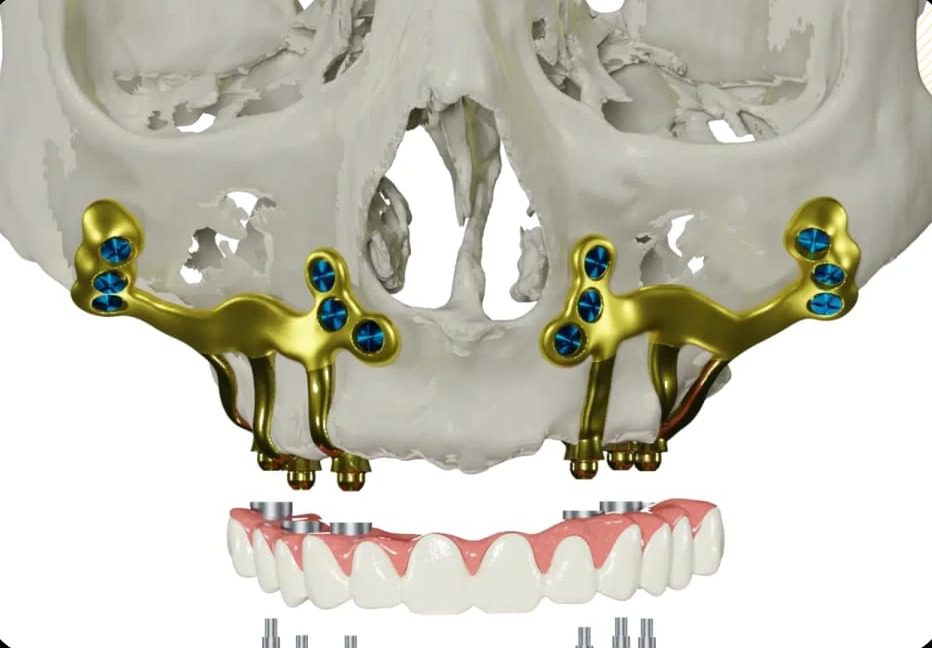
What is a subperiosteal implant?
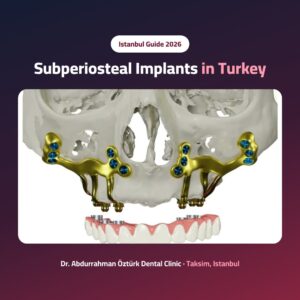
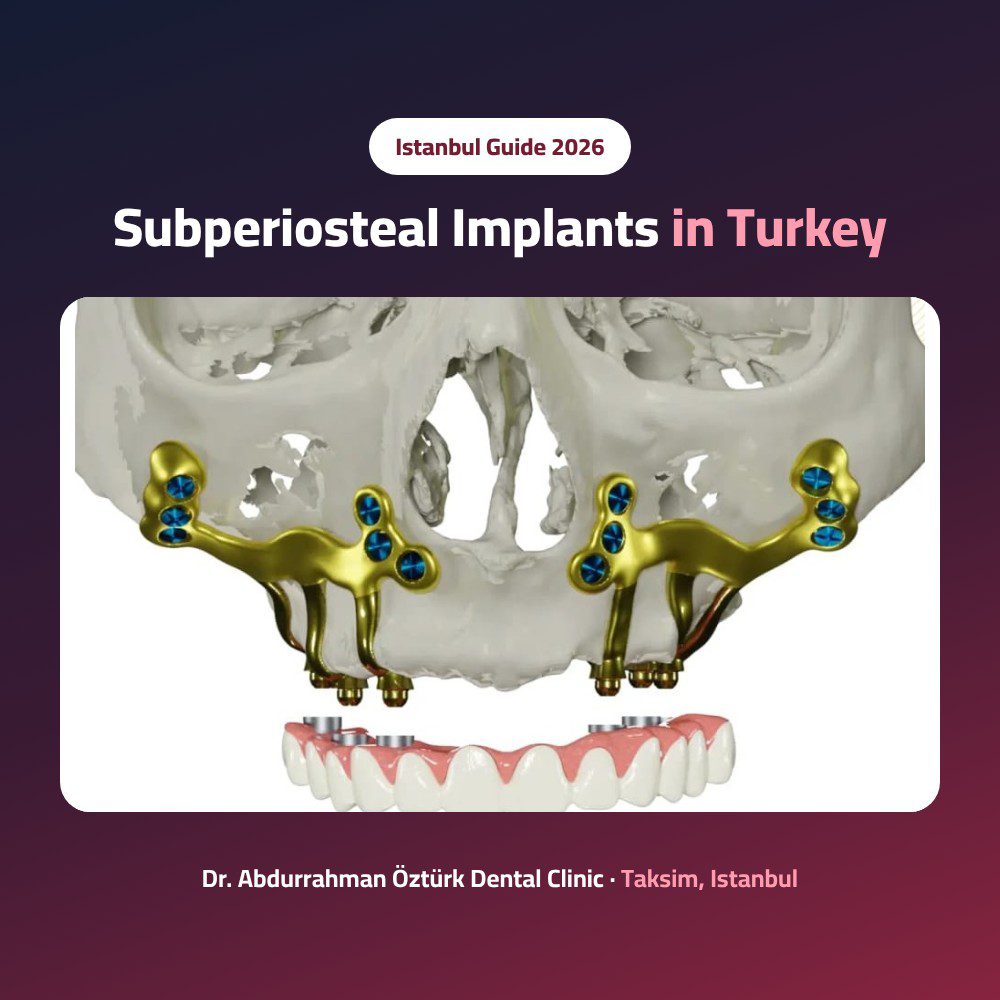
A subperiosteal implant is a custom titanium framework placed on top of the jawbone, beneath the periosteum (the thin membrane covering the bone) and the gum. Posts on the framework come through the gum and support a bridge or individual teeth.
The name describes the position: "sub" means under and "periosteum" is the bone lining. Dental implants are generally grouped into three types by where they sit: endosteal (in the bone), subperiosteal (on the bone) and transosteal (through the bone) [4][7].
The idea is not new. Subperiosteal implants were first used in the 1940s. They were later largely abandoned because the frameworks, made from impressions taken directly on the bone, did not fit precisely and had frequent complications [2].
What changed is the technology. Today the framework is designed on a 3D CBCT scan and made by additive manufacturing (3D metal printing) in titanium. It is fixed to the bone with screws, which gives a closer fit and better initial stability than older designs [4].
How is it different from regular (endosteal) implants?
Most dental implants used today are endosteal, or root-form, implants: titanium screws placed into the jawbone, where they fuse with the bone over a few months [6]. They need enough bone height and width to hold them.
A subperiosteal implant does not need bone depth, because it does not go into the bone. It spreads the load over the bone surface instead.
| Feature | Endosteal (root-form) implant | Subperiosteal implant |
|---|---|---|
| Position | Inside the jawbone | On the bone surface, under the gum |
| Design | Standard sizes chosen from a system | One-piece framework made for one patient |
| Bone needed | Enough height and width, or grafting first | Works on a thin, resorbed ridge |
| Fixation | Fusion with bone (osseointegration) | Screws into the bone plus close surface fit |
| Evidence base | Decades of long-term studies | Mostly short-term studies for modern printed frameworks |
For most patients with reasonable bone, endosteal implants remain the first choice. See our guides to dental implants without a bone graft and 3D-guided implant surgery.
Who is a candidate for subperiosteal implants?
Subperiosteal implants are a specialised option, not a routine one. They are considered when conventional implants would need extensive bone rebuilding first.
Severe bone loss
Advanced resorption of the upper or lower jaw, where bone height or width is too low for standard implants.
Avoiding grafts
Patients who cannot have, or prefer to avoid, bone grafting or sinus augmentation and the long healing time they add.
Failed treatment
People whose earlier implants or bone grafts failed and left a difficult, irregular ridge behind.
Complex anatomy
A very low sinus floor, a nerve close to the ridge surface, or defects after trauma or surgery.
Long-term denture wearers
Years of a removable denture often flatten the ridge. A framework can support fixed teeth instead.
Medically suitable
General health, gum condition and hygiene must allow surgery and long-term maintenance.
When it may not be the right choice
Extra caution, or a different plan, is needed with heavy smoking, uncontrolled diabetes, past radiotherapy to the head and neck, certain bone medications, and poor oral hygiene. Thin or fragile gum tissue also matters, because the gum must cover the framework well. If you still have moderate bone, an endosteal option is usually simpler. Our article on jawbone loss prevention explains why bone shrinks after tooth loss.
Which subperiosteal implant configurations are used?
Because every framework is designed for one jaw, the shape depends on where teeth are missing and how much bone remains.
- Upper jaw (maxilla): the framework usually rests on the ridge and the strong bone around the nose and the cheekbone buttress, avoiding the sinus.
- Lower jaw (mandible): the framework follows the ridge and is designed to stay clear of the nerve that runs through the lower jaw.
- Partial framework: replaces a group of missing teeth in one area, for example the back of one side of the jaw.
- Full-arch framework: supports a complete fixed bridge for a jaw with no teeth. Most published studies concern this use [2].
- Combined plans: a framework in one area may be combined with regular implants where bone allows.
Subperiosteal implants vs bone graft, All-on-4 and zygomatic implants
All these approaches aim at fixed teeth for a jaw with too little bone. They differ in how they handle the missing bone and in how much evidence supports them.
| Option | How it handles bone loss | Extra bone surgery | Published outcome | Best suited for |
|---|---|---|---|---|
| Subperiosteal implant | Custom framework sits on the bone surface | Usually none | 97.8% in function at a mean 21.4 months; partial exposure 25.6% [1] | Severe loss of the upper or lower jaw, failed grafts, complex anatomy |
| Bone graft + regular implants | Rebuilds missing bone first | One or more graft operations | Long-established approach; depends on graft success | Patients who accept a longer, staged plan |
| All-on-4 | Tilts back implants to use the front jawbone | Usually none | Widely used full-arch method | Moderate bone loss with enough front bone |
| Zygomatic implants | Long implants anchor in the cheekbone | Usually none | Mean survival 96.2% at about 6 years (1,349 implants) [5] | Severe upper-jaw loss only |
The key difference: zygomatic implants have longer-term data but work only in the upper jaw. Subperiosteal frameworks can be used in either jaw, but their modern evidence is mostly short-term. Compare our guides to zygomatic implants in Turkey, All-on-4 in Istanbul, bone graft surgery and the sinus lift.
What is the success rate of subperiosteal implants?
Results for modern, digitally designed frameworks are encouraging in the short term. The main concern is soft-tissue complications, not loss of the implant.
- 2024 systematic review: 13 studies, 227 patients and 227 additively manufactured subperiosteal implants, with a weighted mean follow-up of 21.4 months. 97.8% remained in function, with 5 failures. Partial exposure occurred in 25.6% (58 implants), soft-tissue or persistent infection in 5.3%, and interim bridge fracture in 5.2% [1].
- 2025 meta-analysis: 14 studies, 958 patients and 973 full-arch subperiosteal implants. Survival was 100% with the one-stage digital technique after 4 to 38 months, and 85% with the older two-stage technique after 3 to 22 years [2].
- Clinical study: a retrospective study of CAD-CAM subperiosteal implants in atrophic jaws followed 18 patients for 12 months [3].
Both reviews reach the same conclusion: short-term results are good, but medium- and long-term studies and randomised trials are still needed [1][2]. We share this honestly with every patient before treatment.
How is subperiosteal implant treatment done in Istanbul, step by step?
Durations below are typical ranges. Your own schedule is confirmed after the CBCT scan.
Because the framework is custom-made, most patients need two or three visits to Istanbul. Sending a good-quality CBCT in advance can shorten the first stay.
What is recovery like after subperiosteal implant surgery?
Recovery is similar to other full-arch implant surgery. Swelling and some discomfort are expected for several days and are usually controlled with prescribed medication.
- Days 1 to 3: swelling peaks. Rest, cold packs, a soft diet and the prescribed medicines.
- Week 1 to 2: swelling settles and stitches are removed or dissolve. Gentle rinsing keeps the gum clean around the posts.
- Weeks 2 to 8: soft foods are gradually extended. Avoid very hard or sticky foods on the temporary bridge.
- Months 3 to 6: the gum matures around the posts before the final bridge.
For more on comfort during treatment, read how digital planning makes implant surgery more predictable.
What are the risks of subperiosteal implants?
Every surgery has risks. For subperiosteal implants, research points to these:
- Framework exposure: the most common issue. Part of the metal can become visible through the gum. It was reported in 25.6% of modern printed implants and is often partial and manageable, but it needs prompt care [1].
- Infection: soft-tissue or persistent infection was reported in 5.3% [1].
- Peri-implant inflammation: gum inflammation around the posts, similar to peri-implantitis, especially with poor cleaning or smoking.
- Bridge problems: fracture of the interim bridge occurred in 5.2% [1]. Screws can also loosen.
- Removal: in a small number of cases the framework has to be removed. Historically, older designs had more long-term failures than root-form implants [2].
Warning signs: contact the clinic promptly if you notice
Metal showing through the gum; swelling that keeps increasing after day 3; fever; pus or a bad taste around the posts; bleeding or pain that gets worse; or a bridge that feels loose. Early treatment of exposure or infection gives the best chance of keeping the framework.
How do you care for a subperiosteal implant long term?
Daily cleaning and regular check-ups are the most important factors you can control.
- Brush twice daily with a soft brush. Clean under the bridge and around each post with a water flosser and interdental brushes.
- Have a professional check-up and cleaning every 6 months, or as your plan advises.
- Do not smoke. Smoking slows gum healing and raises infection risk.
- Check the gum around the posts in a mirror and report any change early.
- Wear a night guard if you grind your teeth.
Why choose our Istanbul clinic for subperiosteal implants in Turkey?
For a custom framework, planning, surgery and follow-up matter more than anything else. At the Dr. Abdurrahman Öztürk Dental Clinic in Taksim, the whole plan stays with one team.
- 15+ years of experience and thousands of patients treated.
- 5.0 Google rating from 397 reviews: read our Google reviews.
- CBCT imaging and digital planning for every complex implant case.
- Honest case selection: if All-on-4, zygomatic implants or a graft suits you better, we will tell you.
- Lifetime warranty on our implants, with conditions explained in your treatment plan.
- Free examination and free online consultation before you travel.
- Airport transfer and a 5-star hotel arranged by the clinic for patients travelling from abroad.
We do not quote prices online. Every plan depends on your scan and the work needed, and you receive a written plan after your consultation.
Medically reviewed by Dr. Abdurrahman Öztürk
Dentist and medical lead of the Dr. Abdurrahman Öztürk Dental Clinic in Taksim, Istanbul, with more than 15 years of experience in implant and full-arch treatment. This article was medically reviewed against the sources listed below on 25 November 2026.
Where is the clinic in Istanbul?
Dr. Abdurrahman Öztürk Dental Clinic
Gümüşsuyu Mah., Mete Cad., Beyoğlu, Istanbul, Türkiye
Phone and WhatsApp: +90 536 063 00 89
Hours: Monday to Friday 08:00 to 19:00, Saturday 08:00 to 15:00
The clinic is a few minutes' walk from Taksim Square.
Key takeaways
- A subperiosteal implant is a custom titanium framework that sits on the jawbone under the gum and supports fixed teeth.
- It is designed from a CBCT scan and 3D printed, so it can avoid bone grafting in severe bone loss.
- Modern frameworks showed 97.8% in function at a mean of 21.4 months, but partial exposure in 25.6%.
- Long-term evidence is still limited, so case selection and maintenance are essential.
- Bone grafting, All-on-4 and zygomatic implants are alternatives and are compared for every patient.
Find out if a subperiosteal implant is right for you
Send your CBCT or X-ray and a short description of your situation. Our team in Taksim will reply with the options that fit your case.
Ask about subperiosteal implants on WhatsAppRelated articles
Zygomatic implants in Turkey Dental implants without a bone graft Bone graft surgery for dental implants All-on-4 dental implants in Istanbul Sinus lift surgery guide Jawbone loss prevention Zygomatic implant treatment guide AI-guided implant surgery in IstanbulFrequently asked questions
What is a subperiosteal implant?
It is a custom titanium framework placed on top of the jawbone under the gum and fixed with small screws. Posts come through the gum to hold fixed replacement teeth.
Who needs subperiosteal implants?
Mainly adults with severe jawbone loss who cannot have, or prefer to avoid, bone grafting, and people whose earlier implants or grafts failed.
Do subperiosteal implants need a bone graft?
Usually not. The framework rests on the existing bone surface, so it is designed to avoid grafting or a sinus lift in most suitable cases.
How successful are subperiosteal implants?
A 2024 systematic review of 227 printed frameworks found 97.8% in function after a mean of 21.4 months. Long-term data are still limited.
What is the main risk?
Partial exposure of the framework through the gum, reported in 25.6% of cases in a 2024 review. Infection was reported in 5.3%.
Can subperiosteal implants be used in the lower jaw?
Yes. Frameworks can be designed for the upper or lower jaw, for a full arch or for a partial area, depending on the CBCT scan.
Are subperiosteal implants better than zygomatic implants?
Neither is better in general. Zygomatic implants have longer-term data but are only for the upper jaw. The choice depends on your anatomy and health.
How long does treatment take in Istanbul?
Design and manufacturing typically take a few weeks, and the final bridge usually follows 3 to 6 months after surgery. Most patients need two or three visits.
Is the surgery painful?
It is done under local anaesthesia with sedation, or general anaesthesia. Swelling and discomfort afterwards usually last several days and are controlled with medication.
How do I start?
Send your CBCT or panoramic X-ray on WhatsApp to +90 536 063 00 89 for a free online consultation. A full plan follows your examination.
Sources
- Systematic review of additively manufactured subperiosteal implants. International Journal of Implant Dentistry. 2024. pmc.ncbi.nlm.nih.gov
- Systematic review and meta-analysis of subperiosteal implants for full-arch rehabilitation. Dentistry Journal. 2025. pmc.ncbi.nlm.nih.gov
- Clinical outcomes of CAD-CAM subperiosteal implants for the rehabilitation of atrophic jaws. pmc.ncbi.nlm.nih.gov
- Review of the evolution of custom subperiosteal implants. pmc.ncbi.nlm.nih.gov
- Long-term treatment outcomes with zygomatic implants: a systematic review and meta-analysis. 2023. pmc.ncbi.nlm.nih.gov
- Cleveland Clinic. Dental implants. my.clevelandclinic.org
- Wikipedia. Dental implant. en.wikipedia.org