Dental Crown Turned Black at the Gum Line: What Causes It and Should It Be Replaced?
A black or gray line at the edge of a dental crown can be alarming, especially when the crown is on a front tooth. In some cases, the problem is purely cosmetic and comes from the metal structure beneath the crown. In others, it may be related to gum recession, inflammation, an open crown margin, or decay underneath the restoration.
At Dr. Abdurrahman Ozturk Clinic in Istanbul, the crown, the natural tooth underneath it, and the surrounding gum tissue are evaluated together before deciding whether replacement is necessary. Simply covering the dark line is not enough if the real problem is beneath the crown or in the gum tissue.
Why Is There a Black Line Around My Dental Crown?
The most common causes include a visible metal margin from a porcelain-fused-to-metal crown (PFM), gum recession that exposes the edge of the crown or the tooth root, gum inflammation, or recurrent decay at the crown margin. If the dark line is accompanied by pain, bleeding, swelling, bad taste, odor, or a loose crown, the area should be examined. Not every black line means the crown must be replaced, but the cause should always be identified first.
What Does a Black Line Around a Dental Crown Mean?
A black crown margin usually appears as a thin gray, brown, or black line where the crown meets the gum. It may be barely noticeable at first and become more visible over time.
Patients often notice it more when smiling, after the gum has receded, or when the crown is on a front tooth where even small cosmetic differences are more noticeable.
Common Causes of a Black Line at the Gum Line
Metal Crown Margin
Older porcelain crowns often contain a metal substructure. If the metal edge becomes visible near the gum line, it can appear gray or black.
Gum Recession
Receding gums may expose an area that used to be hidden, including the crown margin or part of the natural tooth root.
Gum Inflammation
Plaque accumulation or an poorly fitting crown may contribute to redness, swelling, bleeding, and changes in the appearance of the gum tissue.
Decay at the Crown Margin
The natural tooth can still develop decay where the crown meets the tooth, especially if bacteria accumulate around an open or difficult-to-clean margin.
Darkened Tooth or Root
A previously treated or discolored tooth may appear darker, especially when gum recession exposes part of the root.
Crown Design or Margin Problem
An overcontoured crown or poorly adapted margin can make cleaning more difficult and affect the appearance of the surrounding gum tissue.
The Most Common Cosmetic Cause: PFM Crowns
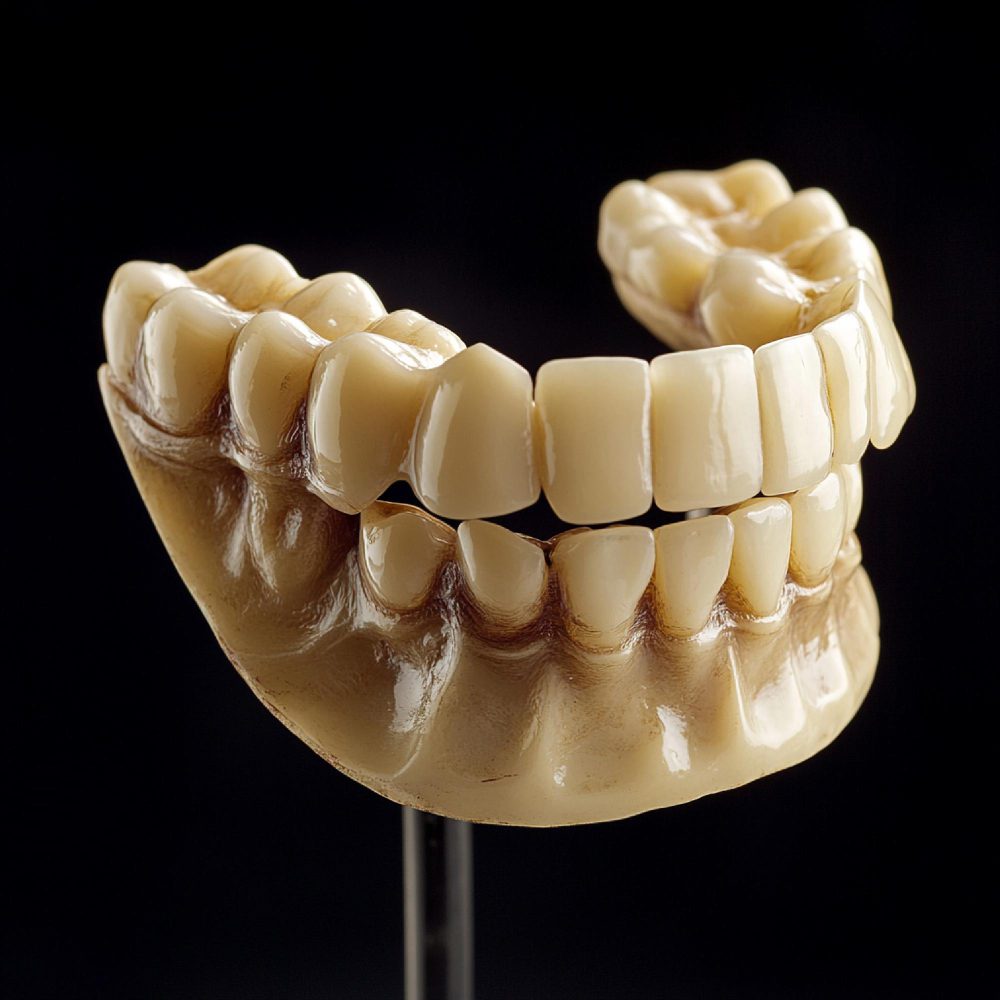
Porcelain-fused-to-metal crowns (PFM) combine a metal framework for strength with an outer porcelain layer designed to resemble a natural tooth.
The cosmetic drawback is that metal does not transmit light in the same way natural enamel or modern all-ceramic materials do. As a result, the crown margin can appear darker.
As long as the gum fully covers the edge, the dark margin may remain hidden. Once the gum recedes slightly, the metal can become visible as a gray or black line.
Zirconia or Porcelain Crown?
If you are considering replacing an older crown, learn how different crown materials compare in strength and aesthetics.
How Can You Tell Metal From Decay?
This is one of the most important distinctions because both problems may look dark in the mirror, but their treatment is completely different.
| Sign | Metal Margin / Cosmetic Issue | Decay or Problem Under the Crown |
|---|---|---|
| Appearance | Often a thin and relatively even gray or dark line | May be irregular or associated with a defective margin |
| Pain | Usually absent | May cause sensitivity or pain, although decay can also be painless |
| Bad Taste or Odor | Not expected from metal alone | May suggest plaque retention, inflammation, or a margin problem |
| Gum Bleeding | Not caused by visible metal alone | May indicate gum inflammation around the crown |
| X-Ray Findings | May be normal | May help identify decay or another underlying problem |
| Treatment | Replacement may be cosmetic | The underlying cause must be treated first |
Does a Black Line Mean the Crown Has Failed?
Not necessarily. A crown may still be stable and function properly even if a dark metal margin is visible.
In that situation, the issue may be primarily cosmetic, particularly on a front tooth.
However, a crown that feels stable can still have problems at the margin, which is why examination is important before assuming the crown is healthy.
When Is Gum Recession the Cause?
Gum recession moves the gum line farther down the root surface, exposing an area that was originally hidden when the crown was placed.
If the crown contains a metal edge, it may suddenly become visible. In other cases, the natural root may appear darker than the crown itself.
Is the Gum Around the Crown Swollen Too?
Swelling or bleeding near the crown should be assessed separately from the cosmetic appearance of the crown margin.
Can Gum Inflammation Make the Crown Area Look Dark?
Gum inflammation can change the color and contour of tissue around a crown. It is often accompanied by redness, swelling, or bleeding during brushing.
Possible causes include plaque accumulation, difficulty cleaning the area, crown contour, crown margin design, or a separate periodontal problem.
In these cases, simply placing a whiter crown does not solve the real issue. The gum should be brought to a healthy and stable condition first.
Can a Tooth Decay Under a Dental Crown?
Yes. A dental crown protects much of the tooth surface, but it does not make the natural tooth immune to decay.
The most important area is where the crown meets the natural tooth. If bacteria reach this margin, decay may develop beneath the restoration without being obvious to the patient.
Signs That May Suggest a Problem Under the Crown
- New sensitivity in a tooth with an older crown
- Pain when chewing or biting
- Persistent bad taste or odor around one crown
- Repeated bleeding or gum inflammation
- A visible or detectable gap at the crown margin
- A loose crown or a change in the bite
How Does a Dentist Diagnose the Cause?
Should the Crown Be Replaced?
Not in every case. The decision depends on the cause, the health of the tooth and gums, the age and condition of the crown, and how important the cosmetic issue is to the patient.
| Situation | Is Replacement Necessary? | Possible Approach |
|---|---|---|
| Visible metal margin but healthy crown | Not always medically necessary | Replacement may be chosen for cosmetic reasons |
| Old or poorly fitting crown | May require replacement | Remove the crown and evaluate the tooth |
| Decay at the margin | Usually requires treatment | Remove decay, restore the tooth, and plan a new crown if appropriate |
| Gum recession with an otherwise healthy crown | Depends on the case | Evaluate the gum and cosmetic goals first |
| Gum inflammation | Not before finding the cause | Treat the gums and reassess the crown |
| Front crown with a visible black line | May be replaced for aesthetics | Choose a material and design better suited to the smile zone |
Does Zirconia Prevent a Black Metal Line?
Zirconia crowns do not contain the traditional metal margin found in many PFM crowns, so they do not produce the same gray metal line.
This can make zirconia a useful option in highly visible areas, especially in the front of the mouth.
However, zirconia does not prevent gum recession, gum disease, or decay at the crown margin. Long-term success depends on much more than the crown material alone.
Zirconia or E.max for Cosmetic Cases?
The choice between zirconia and other ceramic materials such as lithium disilicate depends on tooth location, bite forces, available thickness, the color of the underlying tooth, and the aesthetic requirements of the case.
There is no single material that is automatically best for every patient.
Can the Black Line Be Removed Without Replacing the Crown?
If the discoloration is caused by external staining or deposits, professional cleaning may improve the appearance.
If the dark area is the actual metal edge of the crown, cleaning cannot turn that metal into white ceramic.
In that situation, crown replacement may be the most direct cosmetic option if the appearance is unacceptable to the patient.
Should a Crown Be Replaced While the Gum Is Inflamed?
In cosmetic cases, the condition of the gum should be stabilized first whenever possible.
Inflamed or swollen gum tissue may change in position after treatment. Designing a final crown around unstable gum tissue can compromise the final aesthetic result.
How Is an Old Crown With a Black Line Replaced?
Can Removing an Old Crown Damage the Tooth?
Removing an existing crown is a dental procedure that must be performed carefully, especially when the tooth has extensive previous treatment.
For this reason, a crown that is functioning well should not automatically be removed simply because of a small dark area before the cause and benefit of replacement are properly assessed.
Why Is the Black Line More Noticeable on Front Teeth?
Front teeth are highly visible when smiling and speaking, so even a small difference at the gum line can affect the appearance of the smile.
Light transmission also plays an important role in front-tooth aesthetics, making differences between metal-supported and all-ceramic restorations more noticeable.
What Makes a Crown Look Natural at the Gum Line?
Accurate Margin
A properly adapted margin helps create a smoother transition between the crown and the natural tooth.
Appropriate Material
Crown material should match the location of the tooth, strength requirements, and aesthetic goals.
Healthy Gum Tissue
Even a beautiful crown will not look natural if the gums are red, swollen, or unstable.
Natural Shade
Good aesthetics depend on translucency, brightness, and color harmony—not simply choosing a very white shade.
Natural Emergence Profile
The shape of the crown where it meets the gum should mimic the way a natural tooth emerges from the tissue.
Easy to Clean
A well-designed crown should allow proper brushing and interdental cleaning around the gum line.
Can the Tooth Itself Turn Dark Under the Crown?
Yes. Some teeth become darker because of previous treatment, trauma, or internal changes in tooth structure.
The underlying tooth color can influence the appearance of highly translucent ceramic restorations, which is why crown material should not be chosen based on the external appearance alone.
What if the Crown Is on a Root Canal-Treated Tooth?
A root canal-treated tooth may require a crown depending on how much natural tooth structure remains and where the tooth is located.
If a black line appears around a crown on a root canal-treated tooth, the root canal itself does not explain the discoloration.
The cause may still be a metal margin, gum recession, discoloration of the tooth structure, or another issue that needs separate evaluation.
Can Professional Cleaning Remove the Black Line?
It depends on the cause.
Surface staining and plaque may improve with professional cleaning.
However, if the dark line is caused by exposed metal, an exposed root, or internal tooth discoloration, cleaning alone will not remove it.
When Should an Old Crown Be Replaced?
Crown age alone is not a reason for replacement. Some crowns remain functional for many years, while others need earlier treatment because of mechanical, biological, or cosmetic problems.
Replacement may be considered when there is:
- New decay at the crown margin
- Poor crown fit
- Fractured porcelain or crown material
- Crown mobility
- Gum problems related to crown contour or margin
- A significant cosmetic problem that cannot be corrected conservatively
- Poor shape or color compared with neighboring teeth
Do You Also Have Old Veneers?
Learn which signs may indicate that veneers should be assessed or replaced.
When Should a Black Crown Margin Be Checked Quickly?
Book a dental examination if the dark line is accompanied by:
- Pain or new sensitivity
- Swelling around the crown
- Persistent or repeated gum bleeding
- Bad taste or odor from the area
- A loose crown
- Pain when biting
- Pus or obvious swelling
- A visible gap or fracture at the crown margin
These signs do not automatically mean there is a serious problem, but they make examination more important than treating the discoloration as a cosmetic issue alone.
How Can You Keep the Gum Around a Crown Healthy?
- Brush carefully along the gum line every day.
- Use floss or another interdental cleaning method recommended by your dentist.
- Do not ignore repeated bleeding around a single crown.
- See your dentist if the crown becomes loose or the margin changes.
- Have older crowns checked during routine dental visits.
- Do not rely on appearance alone to judge the health of the tooth under the crown.
Should All Old Metal-Based Crowns Be Replaced With Zirconia?
No. If an older crown is functioning well, the tooth and gums are healthy, and the patient is satisfied with the appearance, there is no rule requiring replacement simply because the crown contains metal.
Removing an existing restoration is itself a dental procedure, so there should be a clear benefit before replacement is recommended.
What Should You Do if the Black Line Affects Your Smile?
The first step is not simply choosing a whiter crown. The dentist should first determine:
- What is causing the dark line?
- Is the gum stable and healthy?
- Is the natural tooth under the crown healthy?
- Is there a visible metal margin?
- Is gum recession contributing to the problem?
- Which crown material is most suitable for that tooth?
Once the cause is understood, treatment can address the real problem rather than simply hiding the visible sign.
Conclusion: Is a Black Line Around a Dental Crown Dangerous?
A black line around a dental crown is not a diagnosis by itself.
It may simply be a metal margin that has become visible after mild gum recession while the crown remains functional. In other cases, inflammation, decay, or a defective crown margin may require treatment.
The best approach is not to automatically replace every crown and not to ignore every dark line. The crown, gum, and natural tooth should be evaluated together before deciding whether gum treatment, tooth treatment, or crown replacement is appropriate.
At Dr. Abdurrahman Ozturk Clinic , crowns, natural teeth, and gum tissue are assessed together before choosing a cosmetic or restorative solution, with the goal of improving the smile while preserving the health of the tooth and surrounding tissues.
Do You Have a Black Line Around a Dental Crown?
Contact Dr. Abdurrahman Ozturk Clinic to find out whether the dark area is related to the crown margin, gum recession, inflammation, or another dental issue, and learn which treatment options may be suitable for your case.
WhatsApp: +1 937 993 5399
Frequently Asked Questions About Black Lines Around Dental Crowns
Common questions about dark crown margins, gum recession, decay, zirconia crowns, and crown replacement.
Why is my dental crown black at the gum line?
Common causes include an exposed metal margin from a PFM crown, gum recession, a darker root surface, gum inflammation, or a problem at the crown margin.
Does a black line around a crown mean decay?
No. A visible metal crown margin can look gray or black even when there is no decay. However, the tooth should be examined if there are symptoms or an abnormal crown margin.
Should a crown be replaced if a black line appears?
Not always. If the crown and tooth are healthy, replacement may be cosmetic. Decay, poor fit, or other defects may make treatment or replacement necessary.
Can zirconia crowns develop a black metal line?
Zirconia crowns do not have the traditional metal margin found in PFM crowns. However, gum recession and gum inflammation can still occur around zirconia crowns.
Can professional cleaning remove the black line?
Surface stains may improve with cleaning, but an exposed metal crown margin cannot be removed by cleaning.
Can gum recession make a crown look black?
Yes. Gum recession may expose a previously hidden metal margin or a darker part of the natural tooth root.
Can a tooth decay under a crown?
Yes. Recurrent decay can develop at the point where the crown meets the natural tooth.
Is bad odor from under a crown normal?
Persistent odor around one crown should be evaluated, especially if it is accompanied by bleeding, swelling, or an unpleasant taste.
Should all old PFM crowns be replaced?
No. If the crown is functioning properly and the tooth and gums are healthy, replacement is not automatically required.
When should I see a dentist quickly?
Seek dental assessment if the dark line is accompanied by pain, swelling, persistent bleeding, pus, a loose crown, or pain when biting.