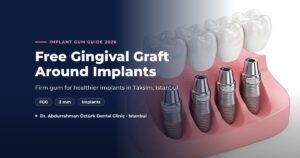
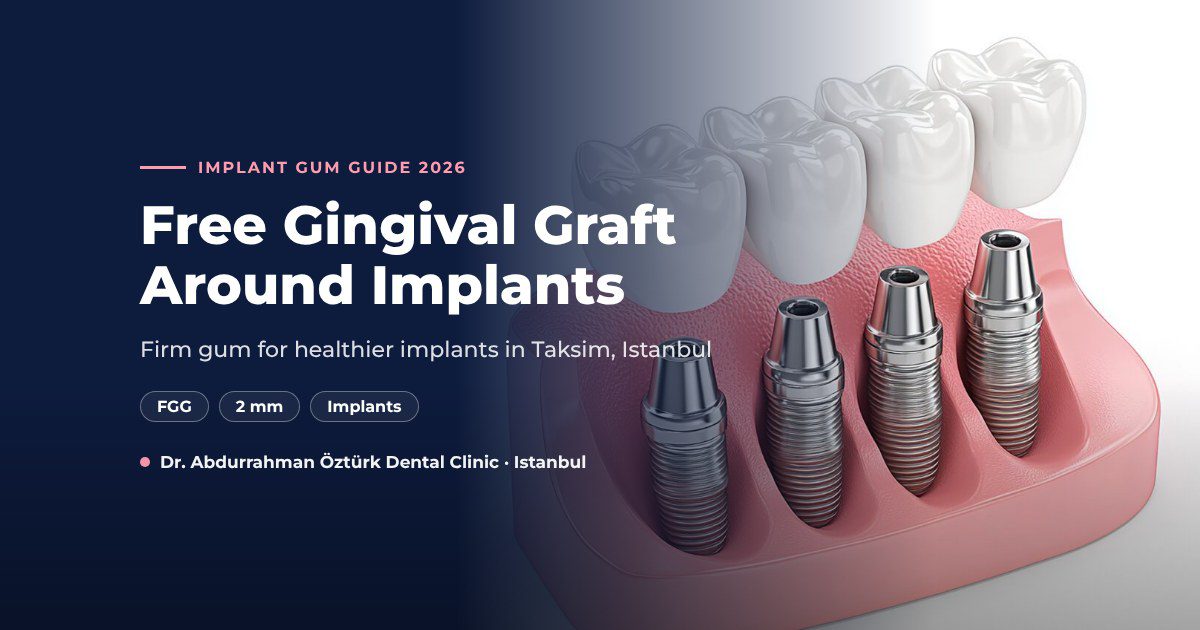
Free Gingival Graft Around Implants: Firm Gum for Healthier Dental Implants in Taksim, Istanbul
A free gingival graft around implants adds a band of firm, keratinized gum around an implant by moving a thin piece of tissue from your palate. It makes brushing easier and helps protect the implant from inflammation and recession.
By the Dr. Abdurrahman Öztürk Dental Clinic in Beyoğlu, near Taksim, Istanbul.
Last updated: 29 November 2026
Quick answer: what is a free gingival graft around implants?
A free gingival graft (FGG) around implants is a small gum surgery that takes a thin strip of firm tissue from the roof of the mouth and stitches it next to a dental implant, creating a band of keratinized mucosa, ideally 2 mm or wider, that resists brushing, inflammation and gum recession.
In a 2026 meta-analysis of 12 cohort studies with 2,646 implants, implants with at least 2 mm of keratinized mucosa had a significantly lower incidence of peri-implantitis than implants with less [1]. The 2022 DGI/SEPA/Osteology consensus calls the free gingival graft the standard of care for widening this tissue.
Important medical note
This article is general information based on the studies listed below and does not replace an examination. Whether you need a graft depends on measurements around your own implants.
Is the gum around your implant thin or sore?
Send close-up photos of the gum around your implants on WhatsApp. Our team will tell you whether a free gingival graft looks useful before you plan a trip to Istanbul.
Ask about a gum graft around implants on WhatsAppThis guide is about grafts that add firm gum around implants. If your concern is exposed roots on natural teeth, read our separate guide to gum graft surgery for root coverage in Turkey, which explains the coronally advanced flap with a connective tissue graft or Mucoderm.
What is keratinized mucosa, and why does it matter around implants?
Keratinized mucosa is the firm, pale pink, tightly attached gum that normally surrounds the necks of teeth; around implants it forms a tough collar that does not move when you talk, chew or brush.
Below it lies alveolar mucosa: thin, red, mobile tissue. When an implant sits only in this tissue, lip movement pulls on its margin and brushing often feels sore.
After tooth loss the ridge shrinks and the firm gum often narrows or disappears, especially in the back of the lower jaw and after years of dentures.
What does the evidence say about the 2 mm threshold?
- Peri-implantitis incidence: a 2026 systematic review of 12 cohort studies (938 patients, 2,646 implants) found that implants with keratinized mucosa of 2 mm or more had a lower risk of developing peri-implantitis (risk ratio 0.56) than implants with less than 2 mm. [1].
- 20-year results: in a prospective study of implants in the back of the lower jaw, peri-implantitis was diagnosed in 4.2% of implants surrounded by keratinized mucosa (including those that received a free gingival graft) versus 25% of implants in mobile mucosa. Half of the patients without firm gum needed additional treatment between years 10 and 20, compared with 5% of those with it [2].
- 10-year results: implants with at least 2 mm of keratinized mucosa had 84% lower odds of a peri-implant disease diagnosis [3].
- Full-arch bridges: in 307 implants supporting fixed full-arch lower bridges followed for 5 years, sites with less than 2 mm of keratinized mucosa showed more plaque and bleeding on the tongue side and more recession on the cheek side [5].
The evidence is not one-sided. A 25-year Swiss cohort with very good hygiene found no difference in peri-implantitis, but implants with no keratinized mucosa had more bone loss and more often showed the implant platform [4]. Firm gum matters most when cleaning is difficult, implants sit at the back, or soreness and recession have started.
When is a free gingival graft around implants recommended?
A graft is not routine. It is considered when missing firm gum causes, or is likely to cause, a problem.
Thin or mobile mucosa
The implant collar sits in red, movable tissue, and the margin moves when you pull your lip or cheek.
Brushing discomfort
Brushing next to the implant stings, so plaque is left behind and the gum bleeds.
Peri-implant recession
The gum is creeping down, and the metal collar or abutment is starting to show.
Before or at uncovering
At second-stage surgery, when the implant is exposed, the gum band can be rebuilt before the final crown is made.
Full-arch and All-on-X
Shallow vestibule and little firm gum after years of dentures make cleaning under a fixed bridge hard.
With peri-implantitis surgery
A graft can be combined with surgical treatment of an infected implant.
If the main problem is a thin gum that lets the grey metal shine through in the front of the mouth, a connective tissue graft placed under the gum is usually the better tool; see our guide to a dental implant metal showing through the gum.
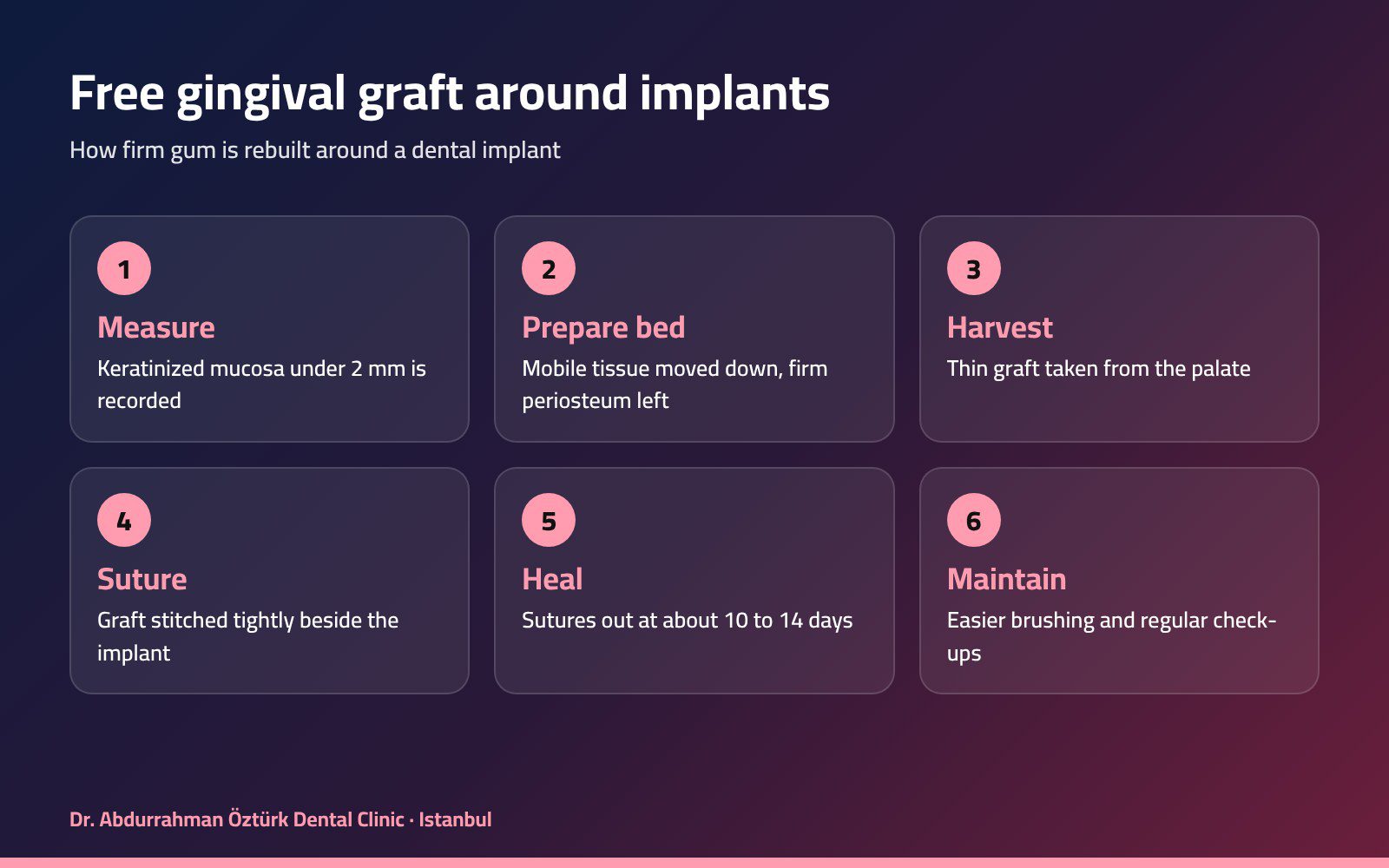
How is a free gingival graft around implants done, step by step?
It is done under local anaesthesia and takes about an hour for one area.
What happens during healing, and will the colour match?
Colour match: palatal tissue keeps its own texture, so the graft often looks paler and thicker than the surrounding gum. This rarely matters at the back or under a full-arch bridge, but in the visible front area another technique is usually chosen.
Free gingival graft vs connective tissue graft vs collagen matrix: which is best?
The free gingival graft is best for width of firm gum, the connective tissue graft for thickness; collagen matrices trade some results for comfort.
| Factor | Free gingival graft (FGG) | Connective tissue graft (CTG) | Collagen matrix substitutes |
|---|---|---|---|
| Main goal | Widen firm keratinized mucosa | Thicken soft tissue, cover metal, improve contour | Widen or thicken without a palatal harvest |
| Donor site | Palate surface | Under the palate surface | None |
| Keratinized mucosa gain | Highest; 4.04 mm versus 1.50 mm with a collagen matrix at 24 months in one study [8] | Moderate, mainly through thickness | Lower; 1.0 mm versus 2.0 mm with FGG at 3 years in a trial [7] |
| Thickness change | Good | Best | Comparable to FGG in some studies [8] |
| Pain and surgery time | More palatal pain, longer surgery | Moderate palatal pain | Shorter surgery and lower pain scores [6] |
| Colour match | Often paler, patch-like | Natural, hidden under the gum | Better colour match than FGG [6] |
| Best suited for | Back teeth, lower jaw, full-arch and All-on-X cases, shallow vestibule | Front implants, thin tissue, grey shine-through | Aesthetic areas, patients who want to avoid palatal surgery, small defects |
A 2024 meta-analysis comparing collagen matrix with free gingival grafts around implants concluded that the graft gave better thickness, while the matrix gave shorter surgery, less pain and better colour match, and could be considered where comfort or aesthetics come first [6].
Who is a good candidate for a free gingival graft around implants?
Good candidates usually have:
- Less than 2 mm of keratinized mucosa, or none, around one or more implants.
- Soreness when brushing, bleeding, plaque build-up or early recession at those implants.
- Back-jaw implants or a full-arch bridge with a shallow vestibule.
- Controlled general health, and willingness to stop smoking around the surgery.
Surgery is postponed with uncontrolled diabetes, active infection or heavy smoking; see smoking and dental implants.
What are the risks of a free gingival graft?
Like any surgery, a free gingival graft has risks:
- Palatal pain and bleeding: the donor site is the most common source of discomfort and, rarely, of delayed bleeding.
- Graft loss: usually from movement or smoking.
- Shrinkage: the graft contracts during the first months, so the final band is narrower than on the day of surgery.
- Colour difference: a paler, thicker patch.
- Infection, swelling or temporary palatal numbness.
Warning signs: contact the clinic promptly if you notice
- Bleeding from the palate that does not stop after 20 minutes of firm pressure with gauze.
- Pain or swelling getting worse after day 3.
- Fever, pus or a bad taste from the graft or the implant.
- The graft moving, coming loose or falling off before the check-up.
- Pain or looseness of the implant itself.
What aftercare helps a gum graft around implants heal?
- Do not brush the grafted area until told, usually about two weeks; use the prescribed mouth rinse.
- Eat soft, cool food for a week; do not pull your lip to look at the graft.
- Avoid smoking, alcohol and hot drinks for the first days.
- After healing, brush the implant with a soft brush and interdental brushes, and keep regular maintenance visits.
Watch: dental implant treatment steps at our clinic
In this one-minute video, Dr. Abdurrahman Öztürk explains implant treatment in Istanbul from scan to final teeth. A free gingival graft is an extra soft tissue step that may be added along the way.
How does a free gingival graft around implants work at our clinic in Istanbul?
At the Dr. Abdurrahman Öztürk Dental Clinic in Beyoğlu, near Taksim, a free gingival graft around implants usually follows this plan:
- Free online consultation: send photos and X-rays for an initial opinion.
- Examination in Istanbul: firm gum width and implant health are measured and the graft chosen.
- Surgery: often in the same visit or the next day, under local anaesthesia, sometimes combined with implant uncovering or peri-implantitis treatment.
- Check-up: a review a few days later.
- Sutures: removed at about 10 to 14 days, at our clinic or by your local dentist, with online follow-up by photos.
For full-arch patients, the graft can be planned together with All-on-X dental implants so the bridge sits on firm gum that is easier to clean. Airport transfer and hotel accommodation can be arranged by the clinic. You receive a written treatment plan after the examination.
Medically reviewed by Dr. Abdurrahman Öztürk
Dentist and medical lead of the Dr. Abdurrahman Öztürk Dental Clinic in Taksim, Istanbul, with more than 15 years of experience and thousands of patients treated, including implant surgery, full-arch treatment and gum grafting. This article was medically reviewed against the sources listed below on 29 November 2026.
Dt. Abdurrahman Öztürk Muayenehanesi holds the Republic of Türkiye Ministry of Health International Health Tourism Authorization Certificate No. ST-5701 (issued 10.03.2025). View the certificate or verify it on turkiye.gov.tr with code DD442835-86F3-48CB-A9DE-500A68C96830.
Where is the clinic in Istanbul?
Dr. Abdurrahman Öztürk Dental Clinic
Gümüşsuyu Mah., Mete Cad., Beyoğlu, Istanbul, Türkiye
Phone and WhatsApp: +90 536 063 00 89
Hours: Monday to Friday 08:00 to 19:00, Saturday 08:00 to 15:00
A few minutes' walk from Taksim Square. Patients rate the clinic 5.0 on Google from 397 reviews.
Key takeaways
- Keratinized mucosa is the firm, attached gum that protects the implant neck.
- Less than 2 mm of it is linked to more plaque, bleeding, recession and peri-implantitis.
- A free gingival graft from the palate is the most effective way to widen this band.
- It suits back teeth, lower jaws and full-arch cases best; the front often needs a connective tissue graft.
- Collagen matrices avoid palatal surgery but usually gain less width.
Plan your implant gum graft in Istanbul
Send photos of the gum around your implants and we will reply with an initial opinion and next steps.
Ask about a gum graft around implants on WhatsApp Periodontal surgery at our clinicRelated articles
Gum graft surgery in Turkey: root coverage with CAF, CTG or Mucoderm Peri-implantitis treatment in Turkey Dental implants in Istanbul, Turkey Periodontal surgery and gum grafting in Istanbul Periodontal surgery and gum grafting in Istanbul (Aident Clinic) Gum grafting in Istanbul (Taksim Clinics) All-on-X dental implants in Istanbul (Taksim Clinics) Gum graft around a dental implantFrequently asked questions about free gingival grafts around implants
What is a free gingival graft around implants?
A small surgery that moves a thin strip of firm tissue from the palate to the area next to an implant, to create a band of keratinized gum.
How much firm gum should an implant have?
Most studies use 2 mm as the reference. Implants with at least 2 mm of keratinized mucosa show less plaque, bleeding, recession and peri-implantitis.
Does every implant need a gum graft?
No. A graft is considered when firm gum is missing or under 2 mm and there is soreness, bleeding, recession or difficult cleaning.
Does a free gingival graft hurt?
It is done under local anaesthesia. Afterwards the palate is usually sore for several days and is more uncomfortable than the implant site.
When are the stitches removed?
Usually after about 10 to 14 days.
Will the graft match the colour of my gum?
Often not exactly. A free gingival graft tends to look paler, so it is mainly used in the back of the mouth or under full-arch bridges.
Is a collagen matrix as good as a free gingival graft?
It is more comfortable and matches colour better, but studies show it usually gains less width of firm gum than a free gingival graft.
Can a free gingival graft be done for All-on-4 or All-on-X?
Yes. It is often used in full-arch cases where years of dentures left a shallow vestibule and little firm gum.
Can the graft be done when the implant is uncovered?
Yes. Second-stage surgery is a common time to rebuild the firm gum before the final crown or bridge is made.
Sources
- Dos Reis INR, Thoma DS, et al. Keratinized mucosa width and incidence of peri-implant diseases: a systematic review with meta-analysis. Journal of Periodontal Research. 2026. pmc.ncbi.nlm.nih.gov
- Roccuzzo A, et al. Role of keratinized mucosa on the risk of peri-implant diseases and soft tissue dehiscence in the posterior mandible: a 20-year prospective cohort study. Journal of Periodontal Research. 2025. pmc.ncbi.nlm.nih.gov
- da Costa Deller FA, Perussolo J, et al. The role of the keratinized mucosa in peri-implant diseases onset and brushing discomfort: a 10-year follow-up. Clinical Oral Implants Research. 2026. pmc.ncbi.nlm.nih.gov
- Couso-Queiruga E, et al. Impact of keratinized mucosa width and mucosal thickness on implant outcomes and brushing discomfort: a 25-year cohort study. Journal of Clinical Periodontology. 2026. pmc.ncbi.nlm.nih.gov
- Schrott AR, et al. Five-year evaluation of the influence of keratinized mucosa on peri-implant soft-tissue health and stability around implants supporting full-arch mandibular fixed prostheses. Clinical Oral Implants Research. 2009. pmc.ncbi.nlm.nih.gov
- Atieh MA, et al. Xenogeneic collagen matrix versus free gingival graft for augmenting peri-implant keratinized mucosa around dental implants: a systematic review and meta-analysis. Clinical and Experimental Dental Research. 2024. pmc.ncbi.nlm.nih.gov
- Solonko M, et al. Surgical treatment of peri-implantitis combined with keratinized mucosa augmentation: results of a dual-center 3-year RCT. Clinical Oral Implants Research. 2025. pmc.ncbi.nlm.nih.gov
- Ramanauskaite A, et al. Volumetric changes of porcine collagen matrix and free gingival grafts for soft-tissue grafting to increase the width of keratinized tissue around dental implants. International Journal of Implant Dentistry. 2024. pmc.ncbi.nlm.nih.gov