
Gum Graft Surgery in Turkey: Coronally Advanced Flap with CTG or Mucoderm in Taksim, Istanbul
Gum graft surgery in Turkey covers exposed tooth roots by moving your own gum back over the root and thickening it from underneath, either with a small graft from your palate or with a collagen matrix called Mucoderm.
By the Dr. Abdurrahman Öztürk Dental Clinic in Beyoğlu, near Taksim, Istanbul.
Last updated: 27 November 2026
Quick answer: what is gum graft surgery with a coronally advanced flap?
Gum graft surgery with a coronally advanced flap (CAF) is a periodontal plastic procedure in which the gum below a receded area is loosened, moved up over the exposed root and stitched in place, usually over a connective tissue graft from the palate or a Mucoderm collagen matrix that thickens the gum and helps the result last.
In a Cochrane review of 48 randomised trials, connective tissue graft with CAF gave a slight advantage when both root coverage and more firm gum were the goals [1]. Long-term trials followed for 5 to 20 years reported complete root coverage in at least two thirds of patients treated with CAF plus a connective tissue graft [4].
Important medical note
This article is general information based on the studies listed at the end and does not replace an examination. Whether your recession can be covered, and with which graft, depends on measurements taken in your mouth.
Can your exposed roots be covered?
Send close-up photos of your gums on WhatsApp and our team will tell you whether a gum graft looks suitable before you plan a trip to Istanbul.
Ask about gum graft surgery on WhatsAppWhat is gum recession and why do tooth roots become exposed?
Gum recession (gingival recession) is the movement of the gum margin below the point where the enamel crown meets the root, leaving part of the root surface visible in the mouth.
The root has no enamel, so exposed roots often feel sensitive to cold, wear down faster with brushing and decay more easily.
Recession is very common in adults and becomes more frequent with age. It also tends to progress: in a review of 1,647 untreated recession defects followed for at least two years, 78.1% became deeper over time, even in people with good oral hygiene [7].
Common causes
- Thin gum and thin bone over the root, often present from birth (a thin "phenotype").
- Hard, horizontal brushing.
- Gum disease (periodontitis), which destroys the bone and fibres that hold the gum in place.
- Orthodontic movement that pushes a tooth outside its bony housing.
- Grinding, a tight lip attachment (frenum) or fillings and crowns that end below the gum.
- Smoking, which weakens gum blood supply and healing.
How is gum recession classified: Miller and Cairo RT1, RT2, RT3?
The older Miller classification has four classes. Classes I and II have no loss of gum or bone between the teeth, so full coverage is possible. Class III has some loss between the teeth, so only partial coverage is expected. Class IV has severe loss between the teeth, and coverage is not predictable.
The newer Cairo classification looks at the attachment level between the teeth (interproximal attachment), and is now part of the 2017 World Workshop classification:
RT1
Recession with no attachment loss between the teeth. The papillae are intact. Complete root coverage is a realistic goal.
RT2
Some attachment loss between the teeth, equal to or less than the loss on the front of the root. Partial coverage is the usual goal.
RT3
Attachment loss between the teeth greater than on the front. Full coverage is not expected; the focus shifts to stability and comfort.
When Cairo and colleagues tested this system on 116 recessions, two examiners agreed almost perfectly (correlation 0.86), and the RT class predicted the amount of recession reduction six months after surgery [2].

Who is a good candidate for gum graft surgery?
Root coverage works best when the gum is otherwise healthy and the cause is controlled. Good candidates usually have:
- RT1 or mild RT2 recession, ideally on front teeth or premolars.
- Sensitivity, visible long teeth, or a notch at the gum line that bothers them.
- Thin gum likely to recede further, for example before braces or a crown.
- No active periodontitis, or periodontitis already treated.
- Good daily cleaning and no smoking around the surgery.
Surgery is postponed with active gum infection, uncontrolled diabetes, heavy smoking or deep RT3 defects; then gum disease treatment or scaling and root planing comes first.
How is a coronally advanced flap done, step by step?
A single area usually takes one to two hours under local anaesthesia.
CAF can also be done alone, without any graft, when the gum is already thick. However, a 2019 meta-analysis of 15 randomised trials followed for at least two years found that mean root coverage after CAF alone dropped by about 7 percentage points over time, while CAF with a connective tissue graft stayed stable [8].
What is a connective tissue graft and what is Mucoderm?
A connective tissue graft (CTG) is a thin strip of the dense tissue taken from under the surface of your own palate, placed beneath the gum to make it thicker. It is the reference standard for root coverage [3].
Mucoderm is a collagen matrix made from purified pig skin (a porcine acellular dermal matrix), used in place of your own graft so that no tissue has to be taken from the palate. Your own vessels and cells grow into it and gradually replace it.
CTG or Mucoderm: which is better for you?
Both work under a coronally advanced flap. The choice is a trade-off between the strongest results and an easier recovery.
| Factor | Connective tissue graft (palate) | Mucoderm (porcine collagen matrix) |
|---|---|---|
| Donor site | Yes, from the palate | None |
| Discomfort | Higher; the palate is often the sorest area for several days | Lower; only the treated gum heals |
| Gum thickness gain | Greatest, with more firm (keratinised) gum [5] | Good, but on average less than CTG [5] |
| Root coverage | Highest mean and complete root coverage in reviews [1][3] | About 11 to 13 percentage points lower mean coverage than CTG at 6 to 12 months [5] |
| Amount available | Limited by palate size | Not limited; useful for several teeth |
| Evidence | Decades of trials, including 5 to 20 year follow-up [4] | Newer; long-term data are fewer |
| Best indications | Deeper single recessions, thin gum, highest aesthetic demand | Shallow to moderate recessions, several teeth, thin palate or patients who want to avoid a second site |
A 2026 meta-analysis of 16 randomised trials (632 patients, 1,878 recessions) found that CTG gave greater mean root coverage than porcine xenogeneic matrices, along with more attachment gain and firm gum. The authors still called these substitutes "a promising alternative" when patient comfort is a priority [5].
How much of the root can be covered? What the studies show
Studies report mean root coverage (average percentage of root covered) and complete root coverage (share of sites covered up to the enamel line).
- CAF + CTG, best overall: a systematic review of 51 randomised trials (1,574 patients, 1,744 recessions) found that CAF + CTG achieved the best results for single recessions, with or without loss between the teeth [3].
- Long term: in trials followed for 5 to 20 years, CAF + CTG left residual recession of 0.5 mm or less and kept complete coverage in at least two thirds of patients [4].
- Graft vs collagen matrix in a tunnel: in a split-mouth trial of 91 lower-jaw recessions, mean root coverage was 83.1% with CTG and 53.2% with a collagen matrix; complete coverage was 67% versus 20% [6].
- Substitutes overall: the Cochrane review found weak evidence that acellular dermal matrices come closest to CTG results [1].
These are group averages. Your result depends mostly on the RT class, gum thickness, tooth position, smoking and protection of the area while it heals.
How long does healing take after gum graft surgery?
What aftercare helps the graft take?
- Do not brush the treated gum until the dentist says so, usually about two weeks; use the prescribed mouth rinse instead.
- Do not pull your lip to look at the area. This can tear the stitches or move the flap.
- Eat soft, cool food for a week and chew on the other side.
- Do not smoke. Smoking is linked to poorer root coverage.
- Take medicines exactly as prescribed and wear the palate plate if one was given.
- Afterwards, switch to an extra-soft brush and gentle technique from then on, and protect the area with a night guard if you grind your teeth (see our bruxism guide).
What are the risks and warning signs after gum grafting?
Like any surgery, gum grafting carries risks: bleeding (mostly from the palate), swelling, bruising, infection, temporary sensitivity, and partial or full loss of the graft. Recession can also return over the years, more often after CAF alone [8].
Contact the clinic promptly if you notice
- Bleeding from the palate or gum that does not stop after 20 minutes of firm pressure with gauze.
- Pain or swelling getting worse after day 3.
- Fever, pus or a bad taste from the surgical area.
- The graft looking loose, moving, or turning grey or white and coming away.
- Stitches coming out early.
What are the alternatives to CAF with a graft?
Tunnel technique
The gum is lifted through small openings without cutting the papillae, then placed over a graft. Useful for several neighbouring teeth.
Free gingival graft
A surface graft from the palate, mainly to add firm gum where there is almost none. It covers roots less well and the colour can differ.
Composite or combined
Where the root has a worn notch, a tooth-coloured filling can restore part of it while a graft covers the rest.
For sensitivity alone, desensitising products may be enough; see our tooth sensitivity treatment page.
How does gum graft surgery work at our clinic in Istanbul?
At the Dr. Abdurrahman Öztürk Dental Clinic in Beyoğlu, near Taksim, gum graft surgery usually follows this plan:
- Free online consultation: you send photos and any X-rays; we give an initial opinion.
- Examination in Istanbul: recession measured, RT class confirmed and graft choice (CTG or Mucoderm) discussed.
- Surgery: often in the same visit or the following day, under local anaesthesia.
- Check-up: a review a few days after surgery.
- Sutures: removed at about 10 to 14 days, at our clinic or by your local dentist, with online follow-up by photos.
Airport transfer and hotel accommodation can be arranged by the clinic. You receive a written treatment plan after the examination.
Medically reviewed by Dr. Abdurrahman Öztürk
Dentist and medical lead of the Dr. Abdurrahman Öztürk Dental Clinic in Taksim, Istanbul, with more than 15 years of experience and thousands of patients treated, including periodontal and gum surgery. This article was medically reviewed against the sources listed below on 27 November 2026.
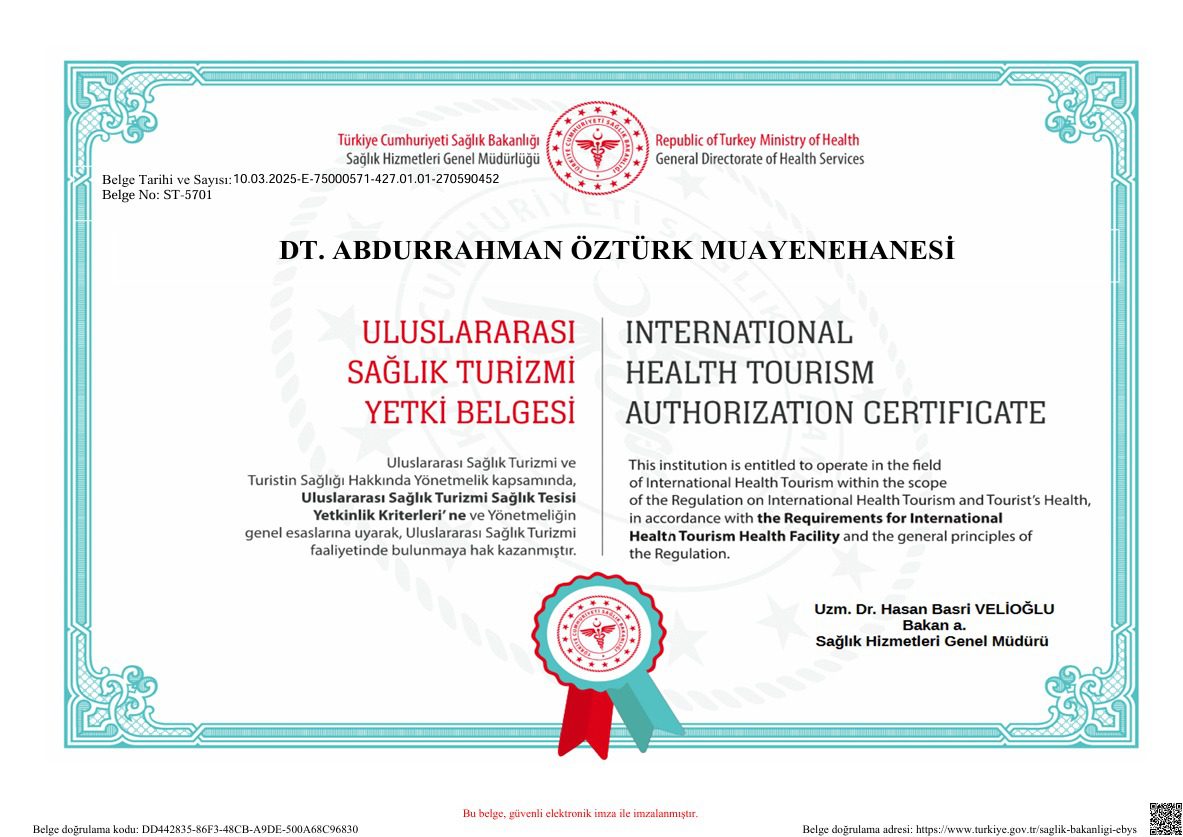
Dt. Abdurrahman Öztürk Muayenehanesi holds the Republic of Türkiye Ministry of Health International Health Tourism Authorization Certificate No. ST-5701 (issued 10.03.2025). View the certificate or verify it on turkiye.gov.tr with code DD442835-86F3-48CB-A9DE-500A68C96830.
Where is the clinic in Istanbul?
Dr. Abdurrahman Öztürk Dental Clinic
Gümüşsuyu Mah., Mete Cad., Beyoğlu, Istanbul, Türkiye
Phone and WhatsApp: +90 536 063 00 89
Hours: Monday to Friday 08:00 to 19:00, Saturday 08:00 to 15:00
A few minutes' walk from Taksim Square. Patients rate the clinic 5.0 on Google from 397 reviews.
Key takeaways
- Exposed roots cause sensitivity and wear, and untreated recession often deepens.
- The Cairo RT class predicts results: full coverage in RT1, partial in RT2, not in RT3.
- CAF moves your own gum back over the root; a graft underneath makes it thicker and more stable.
- A palatal connective tissue graft gives the best coverage and thickness.
- Mucoderm avoids a second site and is more comfortable, with lower average coverage.
- Sutures come out at about 10 to 14 days; the tissue keeps maturing for several months.
Plan your gum graft in Istanbul
Send photos of your receding gums and we will reply with an initial opinion and next steps.
Ask about gum graft surgery on WhatsApp Periodontal surgery at our clinicRelated articles
Periodontal surgery and gum grafting in Istanbul Gum recession and exposed roots: causes and treatments Periodontics in Turkey (Istanbul) Gum disease treatment in Istanbul Periodontal surgery and gum grafting in Istanbul (Aident Clinic) Gum recession: causes and treatment (Taksim Clinics) Gum grafting in Istanbul (Taksim Clinics) What happens if you delay gum disease treatmentFrequently asked questions about gum graft surgery in Turkey
What is a coronally advanced flap?
A gum surgery that loosens the gum below a recession and moves it up to cover the exposed root, then stitches it in place.
Is a connective tissue graft better than Mucoderm?
On average, yes, for root coverage and gum thickness. Mucoderm avoids taking tissue from the palate and is usually more comfortable.
Can all gum recession be covered?
No. Complete coverage is realistic in RT1 recession, partial in RT2, and not expected in RT3, where bone between the teeth is lost.
Does gum graft surgery hurt?
It is done under local anaesthesia. Afterwards there is soreness for a few days, usually more at the palate when your own graft is used.
When are the stitches removed?
Usually after about 10 to 14 days.
How long until the gum looks normal?
It looks settled in a few weeks, but the tissue keeps maturing for several months.
Can recession come back after a gum graft?
It can. Long-term studies show CAF with a connective tissue graft stays more stable than CAF alone, especially with gentle brushing and no smoking.
How many days do I need in Istanbul for a gum graft?
Usually a few days for examination, surgery and a check-up. Stitches can be removed at our clinic or by your local dentist.
Can I smoke after gum graft surgery?
No. Smoking reduces blood supply to the graft and is linked to poorer root coverage.
Sources
- Chambrone L, et al. Root coverage procedures for treating localised and multiple recession-type defects. Cochrane Database of Systematic Reviews. 2018. pmc.ncbi.nlm.nih.gov
- Cairo F, et al. The interproximal clinical attachment level to classify gingival recessions and predict root coverage outcomes. Journal of Clinical Periodontology. 2011. pubmed.ncbi.nlm.nih.gov
- Cairo F, Nieri M, Pagliaro U. Efficacy of periodontal plastic surgery procedures in the treatment of localized facial gingival recessions: a systematic review. Journal of Clinical Periodontology. 2014. pubmed.ncbi.nlm.nih.gov
- Bertl K, et al. Root coverage stability: a systematic overview of controlled clinical trials with at least 5 years of follow-up. Clinical and Experimental Dental Research. 2021. pmc.ncbi.nlm.nih.gov
- Koppolu P, et al. Autogenous connective tissue grafts versus xenogeneic soft tissue substitutes for multiple gingival recessions: systematic review and meta-analysis. Medicina (Kaunas). 2026. pmc.ncbi.nlm.nih.gov
- Pietruska M, et al. Modified coronally advanced tunnel technique with collagen matrix or subepithelial connective tissue graft: a randomized clinical study. Journal of Clinical Periodontology. 2019. pubmed.ncbi.nlm.nih.gov
- Chambrone L, Tatakis DN. Long-term outcomes of untreated buccal gingival recessions: systematic review and meta-analysis. Journal of Periodontology. 2016. pubmed.ncbi.nlm.nih.gov
- Dai A, et al. Long-term stability of root coverage procedures for single gingival recessions: a systematic review and meta-analysis. Journal of Clinical Periodontology. 2019. pubmed.ncbi.nlm.nih.gov