All-on-8 Dental Implants in Turkey: The Complete Guide to Full-Arch Fixed Teeth
All-on-8 dental implants in Turkey offer an advanced solution for patients who have lost all or most of their teeth and want a stable, fixed, and long-term alternative to removable dentures.
Why Do International Patients Choose All-on-8 Dental Implants in Turkey?
Losing most or all of your teeth does more than affect your smile. It can change the way you chew, speak, socialise, and feel about your appearance. It may also reduce facial support and make eating a balanced diet increasingly difficult.
Conventional removable dentures can provide a temporary replacement, but many patients struggle with movement, gum pressure, reduced chewing power, speech difficulties, and the need for denture adhesives.
Modern implant dentistry offers a more stable solution through full-arch rehabilitation. One of the most supportive options is the All-on-8 dental implant technique, which uses eight implants to support a fixed bridge for an entire upper or lower dental arch.
Turkey, particularly Istanbul, has become an important destination for full-mouth implant treatment because it combines experienced implant teams, advanced digital dentistry, modern dental laboratories, international implant systems, and competitive treatment costs.
At Dr. Abdurrahman Ozturk Clinic , full-arch implant cases are planned according to bone volume, facial proportions, bite balance, gum condition, medical history, and the long-term design of the final restoration.
What Are All-on-8 Dental Implants?
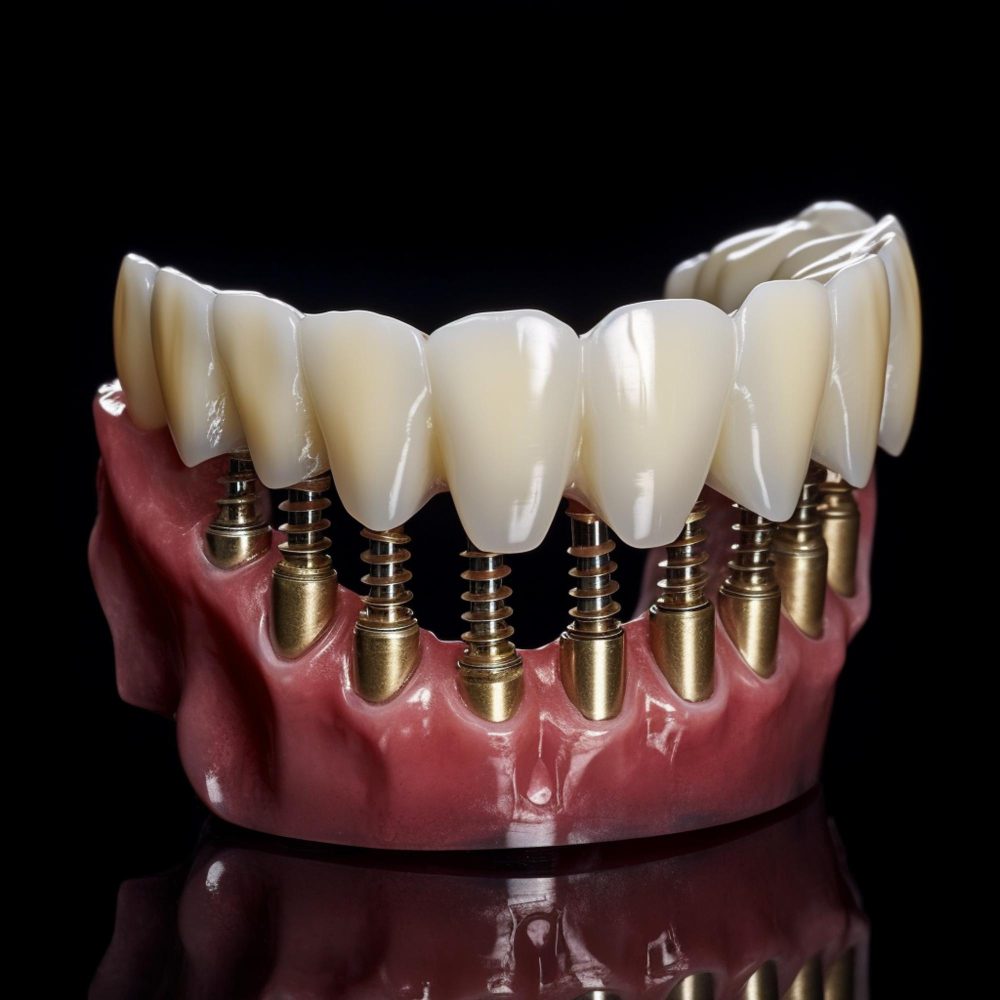
All-on-8 is a full-mouth dental implant concept designed to replace all missing or failing teeth in one arch with a fixed implant-supported bridge.
Instead of placing one implant for every missing tooth, the dentist positions eight implants at carefully selected points within the jawbone. These implants act as stable foundations for a single full-arch prosthesis.
The final bridge commonly includes between 12 and 14 teeth. It may be made from zirconia, reinforced acrylic, PMMA, porcelain, or another suitable restorative material, depending on the patient’s bite, expectations, available space, and treatment plan.
Eight Strategically Positioned Implants
The implants are distributed across the arch to create broad support and improve the distribution of chewing forces.
A Fixed Full-Arch Bridge
A custom-made bridge replaces the visible teeth and restores smile appearance, speech, and chewing function.
Digital Implant Planning
The position, angle, diameter, and length of every implant are selected after analysing three-dimensional scans and bite records.
The bridge is fixed to the implants and is not designed to be removed by the patient. Professional maintenance is still required, and the patient must clean underneath the bridge using suitable interdental tools or a water flosser.
How Does the All-on-8 Dental Implant System Work?
The treatment creates a stable implant-supported foundation across the jaw. The eight implants are normally distributed between the front, premolar, and posterior areas where bone quality and anatomical conditions permit.
When the patient bites or chews, the forces pass from the artificial teeth into the bridge, then into the implants and surrounding jawbone.
The objective is not simply to place a higher number of implants. The real goal is to create a balanced restorative system in which the implants, bridge, bone, and bite work together.
Important elements of treatment planning include:
- Bone height, width, and density.
- The location of nerves and maxillary sinuses.
- The distance and angulation between implants.
- The type and quality of the implant system.
- The position of the future bridge.
- Functional bite distribution.
- Available restorative space.
- Oral hygiene and maintenance ability.
Who May Need All-on-8 Dental Implants?
All-on-8 is generally considered for patients with extensive tooth loss or multiple failing teeth who want a fixed alternative to removable dentures.
Potential candidates may include people with:
- Complete tooth loss in one or both jaws.
- Advanced periodontal disease.
- Multiple severely damaged or loose teeth.
- Failing bridges and extensive dental work.
- Unstable or uncomfortable removable dentures.
- A need for full-mouth rehabilitation.
- Sufficient bone to support eight implants.
The final decision is made only after clinical examination, medical assessment, and three-dimensional radiographic evaluation.
What Are the Main Benefits of All-on-8 Dental Implants?
High Stability
Eight implants can provide broad support for the prosthetic bridge when the jawbone is suitable.
Improved Force Distribution
Chewing pressure may be distributed across more implant support points than in lower-implant systems.
Fixed Teeth
The bridge remains stable during speaking and eating and does not depend on denture adhesive.
Better Chewing Function
After healing, many patients can gradually return to a wider range of foods.
Facial Support
A properly designed bridge can restore lip support and improve the appearance of the lower face.
Long-Term Restorative Potential
Dental implants may remain functional for many years when treatment is well planned and maintained.
Why Is Turkey Popular for All-on-8 Dental Implants?
Turkey has become a major dental tourism destination because patients can access advanced implant treatment, digital technology, skilled dental teams, and lower overall clinical costs than in many Western countries.
International patients commonly choose Turkey for:
- Experienced full-arch implant dentists.
- CBCT imaging and digital implant planning.
- Modern CAD/CAM dental laboratories.
- International dental implant brands.
- Multilingual patient support.
- Competitive treatment costs.
- Coordinated treatment across two visits.
Patients should still assess the clinic carefully. Price alone does not determine quality. The experience of the surgeon, implant brand, prosthetic design, laboratory standards, hygiene protocols, and follow-up system all influence the final result.
All-on-4 vs All-on-6 vs All-on-8: What Is the Difference?
All three systems are designed to restore a complete dental arch with a fixed bridge. The main differences are the number of implants, bone requirements, load distribution, treatment cost, and the complexity of the restorative plan.
| Comparison | All-on-4 | All-on-6 | All-on-8 |
|---|---|---|---|
| Implants per arch | 4 | 6 | 8 |
| Bone requirements | May suit limited bone cases | Usually requires moderate to good bone | Usually requires sufficient bone across the arch |
| Support distribution | Four support points | Six support points | Eight support points |
| Typical cost | Usually lower | Mid-range | Usually higher due to more implants |
| Common indication | Full-arch replacement with limited bone | Patients needing additional support | Patients with sufficient bone who need broad support |
The ideal option depends on anatomy rather than numbers alone. In some patients, four well-positioned implants may be more appropriate than eight implants placed in unsuitable bone.